
espionage
Julian Assange released from prison after agreeing to plea deal with US government

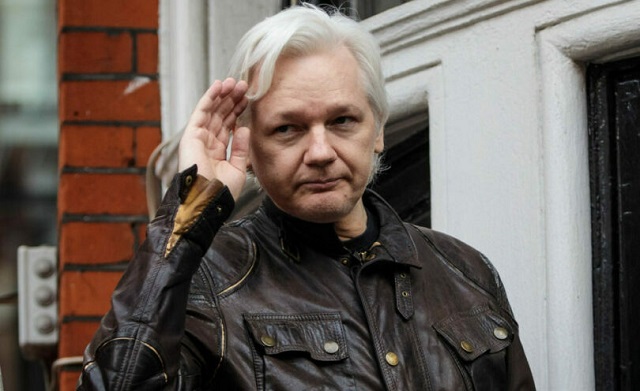
Julian Assange, Embassy Of Ecuador on May 19, 2017, in London, England
From LifeSiteNews
Following a 5-year solitary incarceration, Wikileaks founder Julian Assange was released from a London prison after taking a plea deal with the U.S. Department of Justice regarding the publication of classified information online.
WikiLeaks founder Julian Assange has been released from prison after agreeing to a plea deal with the U.S. Justice Department.
On Monday, the high-profile journalist was released from prison after agreeing to a deal in which he plead guilty for his involvement in publishing classified information received from a whistleblower working inside the U.S. government.
As CNN reported, Assange will receive a 62-month prison sentence according to the terms of the agreements. The sentence equals the time he spent in the high-security prison Belmarsh near London. The time served will be credited toward his sentence, allowing Assange to leave prison immediately and return to his native Australia.
“Julian Assange is free,” WikiLeaks announced in its statement posted on X, formerly Twitter. “He left Belmarsh maximum security prison on the morning of 24 June, after having spent 1901 days there. He was granted bail by the High Court in London and was released at Stansted airport during the afternoon, where he boarded a plane and departed the UK.”
JULIAN ASSANGE IS FREE
Julian Assange is free. He left Belmarsh maximum security prison on the morning of 24 June, after having spent 1901 days there. He was granted bail by the High Court in London and was released at Stansted airport during the afternoon, where he boarded a…
— WikiLeaks (@wikileaks) June 24, 2024
“This is the result of a global campaign that spanned grass-roots organizers, press freedom campaigners, legislators and leaders from across the political spectrum, all the way to the United Nations. This created the space for a long period of negotiations with the US Department of Justice, leading to a deal that has not yet been formally finalized. We will provide more information as soon as possible.”
“After more than five years in a 2×3 metre cell, isolated 23 hours a day, he will soon reunite with his wife Stella Assange, and their children, who have only known their father from behind bars,” the statement continued, adding that “WikiLeaks published groundbreaking stories of government corruption and human rights abuses, holding the powerful accountable for their actions. As editor-in-chief, Julian paid severely for these principles, and for the people’s right to know.”
Assange is expected to officially plead guilty in a court in the Northern Mariana Islands on Wednesday, a U.S. territory located in the Pacific Ocean relatively close to Assange’s native Australia.
Assange faced life in prison in the U.S. for 17 counts of espionage and one charge of computer misuse related to the publication of millions of classified documents by WikiLeaks.
Assange’s legal battle began in 2010 when WikiLeaks published classified documents regarding the wars in Afghanistan and Iraq, including a video that showed a U.S. military helicopter killing several civilians, including two Reuters journalists, in Baghdad, Iraq. The information was provided by former Army intelligence analyst Chelsea Manning. From 2012 to 2019, Assange lived in the Ecuadorian embassy in London under asylum status. After he was arrested by Metropolitan police in 2019 under an extradition warrant from the U.S. government, Assange was imprisoned at Belmarsh, a high-security prison close to London, where he has been held in solitary confinement up until Monday.
According to sources cited by CNN, officials at the Justice Department and the FBI opposed any deal that did not include a guilty plea to a felony by Assange.
Journalist Glenn Greenwald warned of the danger of Assange pleading guilty to a felony for publishing classified information, which, in the eyes of many, was not a crime but a service to society, namely providing information showing that governments are deceiving their citizens.
“I never believed that the Biden administration actually wanted to bring Julian Assange onto American soil to stand trial,” Greenwald said. “Imagine the spectacle that it would have created as Biden heads into an election.”
It would put on Joe Biden’s record that he would be the first American president in history to preside over the imprisonment, not of a source who leaked information, but of someone who published classified information, which every newspaper in the United States does on a regular basis…
The goal of… keeping him in prison was to crush Julian Assange physically and mentally, and they succeeded in doing that…
They wanted to break Assange and simultaneously send a message to any future Assanges that ‘We will ruin your life if you publish our secrets.’
Drawing parallels to NSA whistleblower Edward Snowden not being allowed to return to the U.S., Greenwald said, “It is a deterrent message to keep the ability to hide their own crimes through secrecy, immune from the one vulnerability that they have which is that brave people inside the government leak that information to the public or through the media and reveal what it is they are doing.”



AI-driven surveillance is shifting from spotting suspects to mapping ordinary life, turning everyday travel into a stream of behavioral data
|
|
espionage
Carney Floor Crossing Raises Counterintelligence Questions aimed at China, Former Senior Mountie Argues

Michael Ma has recently attended events with Chinese consulate officials, leaders of a group called CTCCO, and the Toronto “Hongmen,” where diaspora community leaders and Chinese diplomats advocated Beijing’s push to subordinate Taiwan. These same entities have also appeared alongside Canadian politicians at a “Nanjing” memorial in Toronto.

By Garry Clement
Michael Ma’s meeting with consulate-linked officials proves no wrongdoing—but, Garry Clement writes, the timing and optics highlight vulnerabilities Canada still refuses to treat as a security issue.
I spent years in the Royal Canadian Mounted Police learning a simple rule. You assess risk based on capability, intent, and opportunity — not on hope or assumptions. When those three factors align, ignoring them is negligence.
That framework applies directly to Canada’s relationship with the People’s Republic of China — and to recent political events that deserve far more scrutiny than they have received.
Michael Ma’s crossover to the Liberal Party may be completely legitimate, although numerous observers have noted oddities in the timing, messaging, and execution surrounding Ma’s move, which brings Mark Carney within one seat of majority rule.
There is no evidence of wrongdoing.
But from a law enforcement and national security perspective, that is beside the point. Counterintelligence is not about proving guilt after the fact; it is about identifying vulnerabilities before damage is done — and about recognizing when a situation creates avoidable exposure in a known threat environment.
A constellation of ties and public appearances — reported by The Bureau and the National Post — has fueled questions about Ma’s China-facing judgment and vetting. Those reports describe his engagement with a Chinese-Canadian Conservative network that intervened in party leadership politics by urging Erin O’Toole to resign for his “anti-China” stance after 2021 and later calling for Pierre Poilievre’s ouster — while advancing Beijing-aligned framing on key Canada–China disputes.
The National Post has also reported that critics point to Ma’s pro-Beijing community endorsement during his campaign, and his appearance at a Toronto dinner for the Chinese Freemasons — where consular officials used the forum to promote Beijing’s “reunification” agenda for Taiwan. Ma reportedly offered greetings and praised the organization, but did not indicate support for annexation.
Open-source records also show that the same Toronto Chinese Freemasons and leaders Ma has met from a group called CTCCO sponsored and supported Ontario’s “Nanjing Massacre Commemorative Day” initiative (Bill 79) — a campaign celebrated in Chinese state and Party-aligned media, alongside public praise from PRC consular officials in Canada.
China Daily reported in 2018 that the Nanjing memorial was jointly sponsored by CTCCO and the Chinese Freemasons of Canada (Toronto), supported by more than $180,000 in community donations.
Photos show that PRC consular officials and Toronto politicians appeared at related Nanjing memorial ceremonies, including Zhao Wei, the alleged undercover Chinese intelligence agent later expelled from Canada after The Globe and Mail exposed Zhao’s alleged targeting of Conservative MP Michael Chong and his family in Hong Kong.
The fact that Michael Ma recently met with some of the controversial pro-Beijing community figures and organizations described above — including leaders from the Hongmen ecosystem and the CTCCO — does not prove any nefarious intent in either his Conservative candidacy or his decision to cross the floor to Mark Carney.
But it does demonstrate something Ottawa keeps avoiding: the PRC’s influence work is often conducted in plain sight, through community-facing institutions, elite access, and “normal” relationship networks — the very channels that create leverage, deniability, and political pressure over time.
Canada’s intelligence community has been clear.
The Canadian Security Intelligence Service has repeatedly identified the People’s Republic of China as the most active and persistent foreign interference threat facing Canada. These warnings are not abstract. They are rooted in investigations, human intelligence, and allied reporting shared across the Five Eyes intelligence alliance.
At the center of Beijing’s approach is the United Front Work Department — a Chinese Communist Party entity tasked with influencing foreign political systems, cultivating elites, and shaping narratives abroad. In policing terms, it functions as an influence and access network: operating legally where possible, covertly where necessary, and always in service of the Party’s strategic objectives.
What differentiates the People’s Republic of China from most foreign actors is legal compulsion.
Under China’s National Intelligence Law, Chinese citizens and organizations can be compelled to support state intelligence work and to keep that cooperation secret. In practical terms, that creates an inherent vulnerability for democratic societies: coercive leverage — applied through family, travel, business interests, community pressure, and fear.
This does not mean Chinese-Canadians are suspect.
Quite the opposite — many are targets of intimidation themselves. But it does mean the Chinese Communist Party has a mechanism to exert pressure in ways democratic states do not. Ignoring that fact is not tolerance; it is a failure to understand the threat environment.
In the RCMP, we were trained to recognize that foreign interference rarely announces itself. It operates through relationships, access, favors, timing, and silence. It does not require ideological agreement — only opportunity and leverage.
That is why transparency matters. When political figures engage with representatives of an authoritarian state known for interference operations, the burden is not on the public to “prove” concern is justified. The burden is on officials to explain why there is none — and to demonstrate that basic safeguards are in place.
Canada’s allies have already internalized this reality. Australia, the United States, and the United Kingdom have all publicly acknowledged and legislated against People’s Republic of China political interference. Their assessments mirror ours. Their conclusions are the same.
In the United States, the Linda Sun case — covered by The Bureau — illustrates, in the U.S. government’s telling, how United Front–style influence can be both deniable and effective: built through diaspora-facing proxies, insider access, and relationship networks that rarely look like classic espionage until the damage is done.
And this is not a niche concern.
Think tanks in both the United States and Canada — as well as allied research communities in the United Kingdom and Europe — have documented the scale and persistence of these political-influence ecosystems. Nicholas Eftimiades, an associate professor at Penn State and a former senior National Security Agency analyst, has estimated multiple hundreds of such entities are active in the United States. How many operate in Canada is the question Ottawa still refuses to treat with urgency — and, if an upcoming U.S. report is any indication, the answer may be staggering.
Canada’s hesitation to address United Front networks is not due to lack of information. It is due to lack of resolve.
From a law enforcement perspective, this is troubling. You do not wait for a successful compromise before tightening security. You act when the indicators are present — especially when your own intelligence agencies are sounding the alarm.
National security is not ideological. It is practical.
The Bureau is a reader-supported publication.
To receive new posts and support my work, consider becoming a free or paid subscriber.


Georgia county admits illegally certifying 315k ballots in 2020 presidential election
Alberta Next Panel calls to reform how Canada works
Canadian government launches trial version of digital ID for certain licenses, permits
Communist China arrests hundreds of Christians just days before Christmas
-
 Bruce Dowbiggin1 day ago
Be Careful What You Wish For In 2026: Mark Carney With A Majority
-
 Energy1 day ago
New Poll Shows Ontarians See Oil & Gas as Key to Jobs, Economy, and Trade
-
 Fraser Institute1 day ago
Carney government sowing seeds for corruption in Ottawa
-
 International1 day ago
No peace on earth for ISIS: Trump orders Christmas strikes after Christian massacres
-
 Alberta1 day ago
Alberta Next Panel calls for less Ottawa—and it could pay off
-
 Business21 hours ago
Socialism vs. Capitalism
-
 Daily Caller1 day ago
US Halts Construction of Five Offshore Wind Projects Due To National Security
-
 Alberta1 day ago
Alberta project would be “the biggest carbon capture and storage project in the world”