
Bruce Dowbiggin
iPhone Now Collects Your Mental Health Data

From the Brownstone Institute

No data is 100% secure, and this is mental health data. Data that might be extremely embarrassing, career-damaging, or has the potential to disrupt family relationships. Remember, no one knows what new laws, regulations, or more might come to pass years from now.

True Story: The Health app built into iPhones is now collecting as much personal information on the mental health of each and every one of us as they can get a hold of.
Yet, a search on Google and Brave yielded no results on the dangers of sharing such information over the phone or the internet. Seriously, no single MSM has done an article on why such data sharing might be a bad idea?
To start, in sharing such data, you aren’t just sharing your information; iPhone knows exactly who your family members are. In many cases, those phones are connected via family plans.
iPhone mental health assessments not only ask questions about your mental health but can also infer the mental health status of family members, as demonstrated by the image publicly shared by phone on the benefits of a phone mental health assessment.

What could possibly go wrong?
Although the iPhone has historically been known to keep user data “safe,” this is not a given, and there have been hacks and data breaches over the years.
CrowdStrike happened – from just a simple coding error. In 2015, all of my confidential data given to the DoD and the FBI in order to get a security clearance was harvested by the Chinese government, when they hacked into the government’s “super-secret,” and “super-secure” government data storage site. In response, the government offered me a credit report and monitoring of my credit score for a year. Yeah – thanks.
The bottom line – no data is 100% secure, and this is mental health data. Data that might be extremely embarrassing, career-damaging, or has the potential to disrupt family relationships. Remember, no one knows what new laws, regulations, or more might come to pass years from now. This type of information should not be harvested and stored.
Stay Informed with Brownstone Institute. Sign up for updates.
Furthermore, trusting that Apple will never sell that data or pass it off to research groups is very naive. In fact, mental health data is already being mined.
Apple has partnered with various health organizations and academic institutions to conduct health-related studies, such as Harvard T.H. Chan School of Public Health, Brigham and Women’s Hospital, and the University of Michigan on various health studies. Apple also collaborates with the University of California, Los Angeles (UCLA) on a Digital Mental Health Study. This study likely utilizes data collected through Apple devices to investigate mental health patterns and outcomes. Trusting that the user identifiers have been completely stripped before that data is passed on is a risk that one takes when entering such information into an iPhone.

“Connect with resources.”
So how does Apple benefit? At this time, it appears that Apple is selling advertising of various mental health services by “connecting” services to people’s phones. Apple writes that “These assessments can help users determine their risk level, connect to resources available in their region, and create a PDF to share with their doctor.”
That might mean that if one presses the depressed button in the mental health assessment, Apple will place ads on the search engine for anti-depressants or physicians that prescribe them.
Why would that example be relevant, and which pharmaceutical companies might benefit?
iPhone has developed their mental health assessment with an “educational grant” from Pfizer!

Pfizer manufactures and sells Zoloft, Effexor, Pristiq, and Sinequan formulations. Together the sales revenue for these drugs is in the billions each year:
From 2015 to 2018, 13.2% of American adults reported taking antidepressant medication within the past 30 days, with sertraline (Zoloft) being one of the most common. Even off-patent, there were 39.2 million prescriptions filled with an annual sales revenue of 470 million.
Effexor XR is an antidepressant medication that was originally developed by Wyeth (now part of Pfizer). In 2010, when the first generic version of Effexor XR was introduced in the United States, the brand name product had annual sales of approximately $2.75 billion. By 2013, due to generic competition, Pfizer’s sales of Effexor XR dropped to $440 million.
According to IMS Health data, in 2016, Pristiq (desvenlafaxine) had annual sales of approximately $883 million in the United States, although sales appear to have fluctuated over the years.
The bottom line is that Pfizer is not supplying educational grants to develop mental health assessment software for Apple out of the “goodness of their heart.” Mental health inventions via medication are a big business, and these companies are looking to profit.
This is just one way that Apple is using surveillance capitalism by data mining mental health status and then selling access to that data to Big Pharma, Big Tech, physician and insurance companies, etc.
How this information, which once released or leaked, can never be returned with privacies intact, will be used in the future is unknown.
If the setting for sharing research on health conditions has not been deactivated, this information will go into a database somewhere. It is only Apple’s assurance that your identification has been stripped from the data. Further, your mental health information will be uploaded to the cloud and will be used as a behavioral future. To be shared, packaged, sold, used to influence your decision-making, etc.
I am wary of the highly profitable industry that has been built up around “mental disorders.” Over the years, the American Psychiatric Association and the fields of psychology and psychiatry have hurt individuals and families by both classifying diseases and disorders incorrectly and by developing treatments and therapies that were and are dangerous. Many are still in use. Here are a few examples:
- There are estimates that 50,000 lobotomies were performed in the United States, with most occurring between 1949 and 1952. In 1949, the Nobel Prize in Physiology or Medicine was awarded to António Egas Moniz for his development of the lobotomy procedure.
- Homosexuality was classified as a mental disorder in 1952 with the publication of the first Diagnostic and Statistical Manual of Mental Disorders (DSM-I) by the American Psychiatric Association (APA). It was listed under “sociopathic personality disturbance.” This classification remained in place until 1973.
- Selective Serotonin Reuptake Inhibitors (SSRIs) are a widely prescribed class of antidepressant medications. There is a link between SSRIs and increased risk of violent crime convictions, and other research has shown an increase in self-harm and aggression in children and adolescents taking SSRIs.
- The APA supports access to affirming and supportive treatment for “transgendered” children, including mental health services, puberty suppression and medical transition support.
- The APA believes that gender identity develops in early childhood, and some children may not identify with their assigned sex at birth.
- Asperger’s syndrome was merged into the broader category of autism spectrum disorder (ASD) in the DSM-5 in 2013. Since then, a large number of people have faced discrimination and barriers to entry into higher-paying positions. Children handed such a diagnosis also can suffer a lack of confidence in their ability to manage relationships effectively, which can easily carry on to adulthood.
These are just a few of the many, many ways the American Psychiatric Association and the fields of psychology and psychiatry have gotten things very wrong.
- A survey of more than 500 social and personality psychologists published in 2012 found that only 6 percent identified as conservative overall, implying that 94% were liberal or moderate.
- At a 2011 Society for Personality and Social Psychology annual meeting, when attendees were asked to identify their political views, only three hands out of about a thousand went up for “conservative” or on the right.
The liberal bias in psychology influences findings on conservative behaviors.
To bring this back to the use of software applications and the iPhone mental health app in particular, be aware that these software programs are being developed by people with a liberal bias and who will view the beliefs of conservatives negatively. What this means for future use of this data is unknown, but it can’t be good.
If you do choose to use the mental health applications, which mainstream media has nothing but praise for, be aware – there are alligators in those waters.
But sure that the data sharing mode, particularly giving data access to researchers is turned off. But even then, don’t be surprised if your phone begins planting messages about the benefits, SSRIs, or other anti-depressant drugs into your everyday searches. Or maybe your alcohol use or tobacco use data will be used to supply you with advertisements on the latest ways to reduce intake or how to find a good mental health facility. These messages may very well include neuro-linguistic programming methods and nudging, to push you into treatment modalities. But honestly, it is all for your “own good and for the benefit of your family.”

Now, the iPhone and the watch can be valuable tools. The EKG, blood oxygen, and heart rate monitoring are fantastic tools for those who suffer from cardiac disorders. I have found them to be extremely helpful.
My wife, Jill is often motivated by getting more walking steps each week via her iWatch tracker.
Just be aware that these programs can be invasive. Data is never 100% secure and it is being used. We just don’t know all the details.
Republished from the author’s Substack
Author


@PaulChampLaw So, Wayne Gretzky flew on an FBI jet in April 2025 with Kash Patel to watch the Capitals? We all make choices…
Canadians always liked to see themselves as a reflective people. Not hurried into extremes. Slow to anger, quick to act on danger. Humble guys like Wayne Gretzky or Bobby Orr.
If there’s one thing that pissed them off it was anyone sucking up to Americans. Unless… they make it BIG in the U.S.. There was a big exemption for Canadians like Gretzky or Orr or Mike Myers who went south to make a fortune. For them the standards didn’t apply. They were heroes of the nation.
Until Donald Trump. Any Canadian hero not calling him Cheeto or Orange Man Bad or Hitler can expect to receive the mark of Cain from the Left huddling in the Great White North. Anyone excoriating POTUS 45/ 47 , however, is given a lifetime hall pass. No exceptions.

As Gretzky has learned again. Sunday a new photo emerged of the greatest offensive star in NHL history playing golf with the president at his Jupiter, Florida, golf course— the one where Ryan Wesley Routh tried to assassinate Trump. This led to the same predictable rending of garments and clutching of pearls that greeted Gretzky’s earlier declaration of loyalty to The Worst Human Being Ever®. Traitor is now the mildest description of 99 chez nous.
Give the Gretzkys credit, they didn’t disguise their decision. After Trump’s stunning (to some) win last November, Janet Gretzky cooed, “Congratulations Mr. President Donald J Trump ♥️🤍💙🇺🇸 You did it, You deserved it, you earned every bit of it. The world is a better place to have you as our Leader. Proud to be an American. Thank you for being such a great friend. May God keep watching over you ♥️🙏🏻♥️ Love our family to yours !”

The incensed Canadian left swung into action. “University of Alberta professor Robert Summers @RJSCity: “He’s been a pretty unlikable guy for a long time, this just further solidifies it. @ktownkeith: “Gretzky is disgusting and pathetic. I will celebrate when Ovechkin breaks his record. Also FYI, Mario was the best hockey player ever, not Whine Gretzky.” “People should burn all their old hockey jersey and cards of this guy. A shame”. And those were the nice ones.
The bile harkened to Orr supporting Trump in 2020. In our column at the time we noted the furious aftermath from Canadian hockey worshippers. Canadian sports media called Trump a “monster”, a “racist” and “a totalitarian”. You could heat most of the GTA with the steam emitted by their indignation at Orr having the temerity to speak out politically.

Orr has taken a low profile since, as even some in his hometown of Parry Sound wants nothing to do with him. “Poor Parry Sound,” tweeted Mary Lou George on Oct. 31, 2020. “What a disgrace #BobbyOrr has turned out to be. Guess he believes bragging about assaulting women really is just locker room talk since he wants Trump on his team. Sad.”
As with everything in the current McCoys vs Hartfields feud between the countries the venom launched at Gretzky’s decision to support Trump is underscored by the quaint notion that Canada is anything like it was when Gretzky’s 1988 wedding was a national celebration in Canada.
As the polling from the 2025 Canadian federal election showed young people are fed up with their Boomer parents’ nostalgia for the nation that smuggled the American diplomats out of Iran in 1979. They want economic opportunities and the ability to buy homes. What successive Liberal governments have given them is trans insanity, cities overrun by Hamas protesters and national debt backloaded on their shoulders.
To say nothing of Chinese infiltration of the economy and trade. No wonder they keep trying to change the words to O Canada all the time.
The decisions by Gretzky and Orr, among many expats, is partially due to Trump’s contrarian stance. But it also reflects a distance from the land where they grew up. Mike Myers and Elbows Up played on this sentimental loyalty to help Mark Carney succeed Justin Trudeau. But as more and more financial and talent stacks head south for opportunity (see Nutrien’s decision to ship Saskatchewan potash via the U.S., ignoring B.C.) it’s becoming clear that a reckoning is coming.
Trump’s brusque brushoff of Canada as no better than a 51st state was like an intervention with a friend or family member who’s gotten lost. It was a chance for self examination as we said in this 2018 column, Sometimes An Ingrate Nation.
Instead they bought the fake line that Trump would “invade” the country. Canadians lamented their treatment of “loyal old friend Canada”. But since the Iran heroics what has Canada done to help the U.S.? America has guarded Canada militarily. It has protected the trade lanes where Canadian goods are shipped. It has accepted hundreds of thousands of health patients unable to receive timely treatment in Canada’s single payer system.
It has encouraged Canada an automobile industry. It has allowed Canada’s film and TV industry subsidies. It has (so far) tolerated Canada’s dairy cartels. And it has welcomed Canadians by the millions to holiday or invest in America.
Now list the selfless deeds Canada has performed for America since Ken Taylor squirrelled the diplomats out of Tehran. Um… give us time. We sent Orr and Gretzky to the U.S. to jumpstart hockey. And all the SCTV folks. Canada also became the home for every foaming leftist in America seeking to escape Trump. Beyond that? Diddly squat.
So instead of the prolonged lamentations of the women and men and others of Canada, perhaps Elbows Up should listen to VPOTUS J.D. Vance. “And with all due respect to my Canadian friends, whose politics focus obsessively on the United States: your stagnating living standards have nothing to do with Donald Trump or whatever bogeyman the CBC tells you to blame. The fault lies with your leadership, elected by you.”
Bruce Dowbiggin @dowbboy is the editor of Not The Public Broadcaster A two-time winner of the Gemini Award as Canada’s top television sports broadcaster, his new book Deal With It: The Trades That Stunned The NHL And Changed hockey is now available on Amazon. Inexact Science: The Six Most Compelling Draft Years In NHL History, his previous book with his son Evan, was voted the seventh-best professional hockey book of all time by bookauthority.org . His 2004 book Money Players was voted sixth best on the same list, and is available via brucedowbigginbooks.ca.

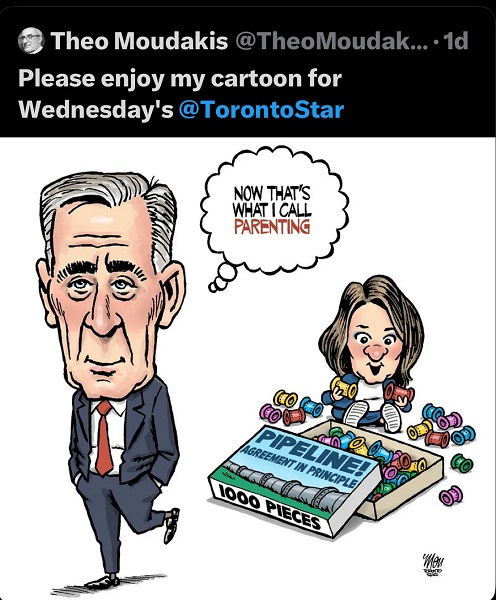
Ottawa and Alberta have reached a memorandum of understanding that paves the way for, among other things,. a new oil pipeline in return for higher carbon taxes.. How’s it doing? B.C. and Quebec both reject the idea. The Liberals former Climate minister resigned his cabinet post.
The most amazing feature of the Mark Carney/Danielle Smith MOU is that both politicians feverishly hope that the deal fails. Carney can tell Quebec that he tried to reason with Smith, and Smith can say she tried to meet the federalists halfway. Failure suits their larger purposes. Carney to fold Canada into Euro climate insanity and Smith into a strong motive for separation.
We’ll have more in. our next column. In the meantime, another Alberta initiative on healthcare has stirred up the hornets of single payer.
To paraphrase Winston Churchill, “Canada’s health system is the worst in the world. Except for all the other systems.” If there is anything left that Canadians agree upon it’s that their provincial healthcare plan is a disaster that needs a boatload of new money and the same old class rhetoric about two-tier healthcare.
Both prescriptions have been tried multiple times since Tommy Douglas made single-payer healthcare a reality. As a result today’s delivery systems are constantly strained to breaking and the money poured in to support it evaporates in red tape and vested interests.
But suggest that Canada adopt the method of somewhere else and you get back stares. Who does it better? How can we copy that? Crickets. Then ask governments to cut back and create efficiencies. No one wants to tell the unions they are the first to move. As a result, operating rooms sit empty for lack of trained nurses and rationed doctors. The system is all dressed with nowhere to go.

There are many earnest people trying their best to fit the square peg in the round hole. But so far it has produced a Frankenstein quilt of private clinics in other provinces handling overflows and American hospitals taking tens of thousands of overflows or critical cases. Ontarians travelling to Quebec for knee surgery. Albertans heading to eastern B.C. for hips and shoulders. Nova Scotians going to Boston for back surgery.
To say nothing of the legions of Canadians on waiting lists for terminal cancer or heart problems who, in despair of dying before seeing a specialist in 18-24 months, voyage to Lithuania, India or Mexico to save their lives. Everyone knows a story of a family member or friend surgery shopping. Every Canadian health authority sympathizes. But little solves the problem.
Which has led to predictable grumbling. @Tablesalt13 if the Liberals hadn’t surged immigration over the last 4-5 years and if all of the money spent on refugees and foreign aid was redirected to health care how much shorter would Canada’s medical waitlists be?

And if any small progress is made the radical armies opposed to two-tiered healthcare raise a stink in the media, stopping that progress in its tracks. Suggesting public/ private healthcare systems is a quick trip to a Toronto Star editorial and losing your next election.
Into the impasse Alberta has introduced Bill 11 to create a parallel private–public surgery system that allows surgeons to perform non-urgent procedures privately under set conditions, moving ahead with the premier’s announcement last week. The government says the approach will shorten wait times and help recruit doctors, while critics argue it risks two-tier care.
The legislation marks a major shift in healthcare reform in Alberta and faces (shock) strong opposition from the NDP which is pairing these reforms with the province’s use of the notwithstanding clause in banning radical trans surgery and medication for minors in the province.
There are examples of two-tiered healthcare elsewhere in the West. France, Ireland, Denmark, Switzerland and Germany, among others, use a dual-tracked system mixing public and private coverages. Reports FHI, “In the most successful European healthcare systems, e.g., Germany and Switzerland, the federal government handles the PEC risk, via national pools and government subsidies, sparing the burden on individual insurers.” While not perfect it hasn’t produced class warfare.
The Americans, meanwhile learned to their chagrin with ObamaCare (the Affordable Care Act, that government healthcare is not the answer. The U.S. heath system replaces government accounting with health insurance rationers as the immoveable force. Many Americans were outside this traditional system, paying out-of-pocket. Under the Obama plan everyone would be forced into a plan, like it or not.
The AFI continues, “ACA has a flawed design. Its architects meant to appeal to the public, promising what the old system could not fully deliver – guaranteed access to affordable health cover and coverage for pre-existing conditions (PECs). But they were wrong about being able to keep your doctor or your old policy if you wanted.
Previously individual policies had to exclude PEC coverage to be financially viable. Yet employer group policies often covered it after a waiting period, but the extra costs were spread over their fellow workers – a real burden on medium and small-sized companies. Under Obamacare, the very high PEC costs are still spread too narrowly – on each of the very few insurers who have agreed to stay as exchange insurers.”
In other words getting a universal system that helps the needy while not degrading treatment is illusory. Alberta is willing to admit that fact. Like agreement on pipelines it will face nothing but headwinds from the diehards (pun intended) who still believe Michael Moore’s fairy tales about a free system in Canada. And will do nothing to bind Canada’s warring factions.
Bruce Dowbiggin @dowbboy is the editor of Not The Public Broadcaster A two-time winner of the Gemini Award as Canada’s top television sports broadcaster, his new book Deal With It: The Trades That Stunned The NHL And Changed hockey is now available on Amazon. Inexact Science: The Six Most Compelling Draft Years In NHL History, his previous book with his son Evan, was voted the seventh-best professional hockey book of all time by bookauthority.org . His 2004 book Money Players was voted sixth best on the same list, and is available via brucedowbigginbooks.ca.


From Underdog to Top Broodmare

Canadians will soon be versed in massive West Coast LPG mega-project
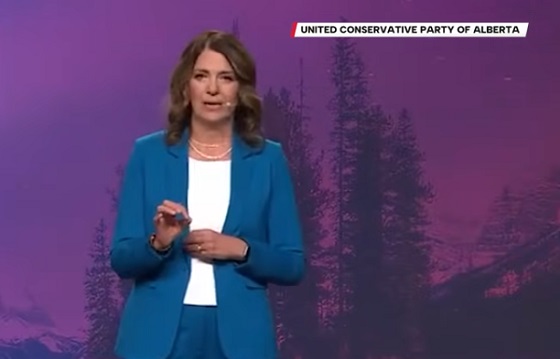
Keynote address of Premier Danielle Smith at 2025 UCP AGM

‘No Critical Thinking’: Parents Sound Alarm As Tech Begins To ‘Replace The Teacher’
-
 Daily Caller23 hours ago
Tech Mogul Gives $6 Billion To 25 Million Kids To Boost Trump Investment Accounts
-
 Alberta8 hours ago
This new Canada–Alberta pipeline agreement will cost you more than you think
-
 Business23 hours ago
Recent price declines don’t solve Toronto’s housing affordability crisis
-
 National21 hours ago
Canada Needs an Alternative to Carney’s One Man Show
-
 Alberta2 days ago
New era of police accountability
-
 Automotive8 hours ago
Power Struggle: Governments start quietly backing away from EV mandates
-
 National2 days ago
Media bound to pay the price for selling their freedom to (selectively) offend
-
 C2C Journal2 days ago
Learning the Truth about “Children’s Graves” and Residential Schools is More Important than Ever