
Great Reset
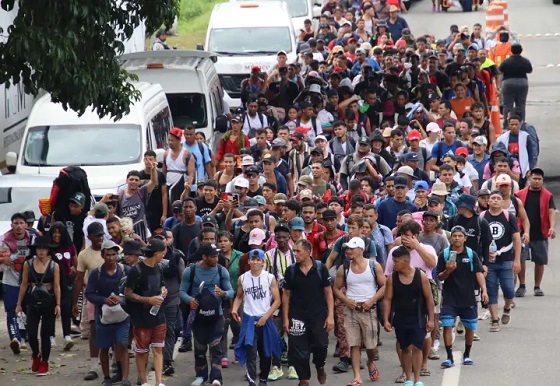
Hundreds of thousands of migrants are being held in southern Mexico until US Election Day

From The Center for Immigration Studies
By Todd Bensman
TAPACHULA, Mexico — This town near the border of Guatemala holds a migrant time bomb ready to go off just after the US presidential election.
The fuse was lit in December 2023, when the Joe Biden-Kamala Harris administration sent senior lieutenants to Mexico to work out the details of what remains a highly mysterious grand diplomatic bargain.
Worried about what the optics of the southern border would do to their re-election chances — though not the migrant crisis itself — the White House wanted to stop the pictures of crowds of people gathered at the wall.
The deal was to have Mexico deploy 32,500 troops to the US border to round up untold thousands of intending border crossers from the northern precincts and force-ship them — “internal deportation” by planes and buses — thousands of miles to Mexico’s southern provinces and entrap them in cities like Tapachula in Chiapas state behind militarized roadblocks.
Mexico closed off most of its freight trains to migrant free riders, bulldozed northern camps, and patrolled relentlessly for more deportee targets.
Meanwhile, the administration increased “parole” programs that flew migrants directly from countries like Venezuela, thus avoiding the border entirely.
The effect was immediate. Illegal border crossings plummeted from an embarrassing, record-breaking 12,000 to 14,000 per day in November and December 2023 to about 3,000 or 4,000 per day before January was even over.
But the crisis isn’t over.
The just-released 2025 Homeland Threat Assessment from the Department of Homeland Security says the decrease in illegal border crossing is largely due to “increased Mexican enforcement efforts.”
What happens if that enforcement stops?
Tapachula is bursting at the seams.
No one really knows how many people are stacked up, but local shelter managers reported to me that they had filled up long ago.
The publisher of Noticia De Tapachula, the daily newspaper, told me 150,000 immigrants were in town at any given time, a 42% increase in the city’s normal population of 350,000. Untold thousands more are stacked up in Villahermosa, a city of 830,000.
Mexico’s response has been to try to spread the immigrants around the southern portion of the country.
I spent time at two different roadside areas where federal immigration officers would call out names from the crowd, who would board buses that delivered them to other regional cities in Chiapas — but NOT beyond them and certainly never beyond Mexico City.
Mexico is still trying to hold up its end of the bargain, at least until November 5, even though more migrants are starting to slip through and making it over the Texas or California borders.
The question is what happens after the American election.
No matter who wins, Mexico might well consider that it more than satisfied its obligation to the current White House occupant and open the floodgates.
If it’s Donald Trump, Americans should expect a massive tidal wave of caravans for the 10 weeks before Inauguration Day. All the migrants I’ve spoken to say they fear a Trump presidency, and will rush to the border in a last-ditch attempt.
If it’s Harris, perhaps the massive tidal wave will go on for the next four years, much like the last four.
Todd Bensman, a senior national security fellow at the Center for Immigration Studies, is the author of “Overrun: How Joe Biden Unleashed the Greatest Border Crisis in U.S. History.”



From StosselTV
Countries all over the world are imposing digital IDs. They tie your identity to everything you do. Spain’s Prime Minister wants “An end to anonymity online!”
Tech privacy expert Naomi Brockwell @NaomiBrockwellTV warns that’s dangerous. “Privacy is not about hiding,” she tells Stossel TV producer Kristin Tokarev. “It’s about an individual’s right to decide for themselves who gets access to their data. A Digital ID… will strip individuals of that choice.”
The new government mandated digital IDs aren’t just a digital version of your driver’s license or passport. “It connects everything,” Brockwell explains. “Your financial decisions, to your social media posts, your likes, the things that you’re watching, places that you’re going… Everything you say will be tied back to who you are.”
And once everything runs through a single government ID, access to services becomes something you need permission for. That’s already a reality in China where citizens are tracked, scored, and punished for “bad” behavior.
Brockwell warns the western world is “skyrocketing in that direction.” She says Americans need to push back now.
———
To make sure you receive the weekly video from Stossel TV, sign up here: https://www.johnstossel.com/#subscrib...
———
Censorship Industrial Complex
US Under Secretary of State Slams UK and EU Over Online Speech Regulation, Announces Release of Files on Past Censorship Efforts


Sarah Rogers’ comments draw a new line in the sand between America’s First Amendment and Europe’s tightening grip on online speech.
|
|


Largest fraud in US history? Independent Journalist visits numerous daycare centres with no children, revealing massive scam
Why Japan wants Western Canadian LNG

“Magnitude cannot be overstated”: Minnesota aid scam may reach $9 billion

Disclosures reveal Minnesota politician’s husband’s companies surged thousands-fold amid Somali fraud crisis
-
Business2 days ago
Disclosures reveal Minnesota politician’s husband’s companies surged thousands-fold amid Somali fraud crisis
-
 Alberta2 days ago
The Canadian Energy Centre’s biggest stories of 2025
-
 Business2 days ago
Resurfaced Video Shows How Somali Scammers Used Day Care Centers To Scam State
-
 Business22 hours ago
The Real Reason Canada’s Health Care System Is Failing
-
 Business2 days ago
Minneapolis day care filmed empty suddenly fills with kids
-
 Business2 days ago
Ottawa Is Still Dodging The China Interference Threat
-
Business22 hours ago
Federal funds FROZEN after massive fraud uncovered: Trump cuts off Minnesota child care money
-
 Opinion14 hours ago
Globally, 2025 had one of the lowest annual death rates from extreme weather in history