
illegal immigration
How to Lower the Risk of New Terror Strikes by Border-Crossing Islamist Extremists

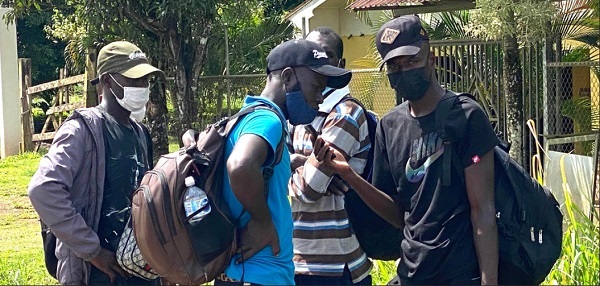
U.S.-bound Mauritanian migrants in Costa Rica near the Nicaraguan border. 2022 Photo by Todd Bensman.
From the Center for Immigration Studies
By Todd Bensman
So a border-crossing illegal immigrant has finally conducted a terror attack just as the FBI Director and the U.S. intelligence community has warned with increasing frequency would happen because of a 2021-2024 mass migration border crisis the New York Times recently concluded was the “largest in U.S. history”, fomented by policies of the Joe Biden administration.
Mauritanian national Sidi Mohammad Abdallahi, who illegally crossed the southern border during it in March 2023, entered the U.S. history books October 26 as the first to validate the long-hypothesized border terror infiltration threat with an attempt to massacre Jews and police in Chicago – as detailed in Part 1 and Part 2 of this “First Blood” series.
Now what? How might the incoming second administration of President Donald Trump reduce the threat of more such attacks with millions of foreign strangers already inside the United States and more constantly trying the southern land border?
Following are some remedies, starting with a highly viable one that comes from a most unexpected quarter, the Democratic administration of President Barack Obama and perhaps best frames where many solutions must aim: a category of illegal aliens the government has long termed “special interest aliens (SIAs)” or variations thereof, for hailing from countries where Islamist terrorist groups operate.
In June 2016, Obama’s DHS Secretary, Jeh Johnson, issued a three-page unclassified memorandum titled “Cross-Border Movement of Special Interest Aliens“. It ordered DHS border security and immigration agency directors to develop a concerted, whole-of-government initiative that would more robustly apply security vetting to SIA border-crossers and much more.

DHS Secretary Jeh Johnson’s 2016 Memo on Special Interest Aliens.
Since 2004 in the aftermath of 9/11, the U.S. Border Patrol and the US intelligence community came up with the SIA category tag to slap on apprehended illegal aliens who hailed from 35 mostly Muslim majority “countries of interest” where Islamist extremism and terrorist groups operated. Mauritania has long been on the intelligence community-created list, and Abdallahi therefore was an SIA.
The SIA tag didn’t mean the aliens were actual terrorists, of course, just that FBI or qualified intelligence officers would take a good, hard look at each to make sure they weren’t. To do that, agents endeavored to conduct intensive in-person interviews with them in detention centers, go through pocket trash and phones, and maybe check with amenable foreign intelligence agencies, looking for terrorism indicators that might weed out for deportation any who turned up as problematic.
Something related to “the increased global movement of SIAs” Johnson mentioned in the memo had clearly spooked him in 2016, perhaps the Muslim immigrants then pouring over European Union border in a mass migration surge, among them some who conducted attacks across the continent. (See: What Terrorist Migration Over European Borders Can Teach About American Border Security.) Perhaps he worried that the SIA security vetting program had fallen into dangerous disrepair a dozen years into it.
“As we all appreciate, SIAs may consist of those who are potential national security threats to our homeland”, the secretary wrote in the 2016 memo. “Thus the need for continued vigilance in this particular area.”
Whatever it was, the Johnson memo demanded the “immediate attention” of underlings to form a “multi-DHS Component ‘SIA Joint Action Group.’” The memo outlined plan objectives. Intelligence collection and analysis, Johnson wrote, would drive efforts to “counter the threats posed by the smuggling of SIAs.” Coordinated investigations would “bring down organizations involved in the smuggling of SIAs into and within the United States”, he wrote.
Border and port of entry operations capacities would “help us identify and interdict SIAs of national security concern who attempt to enter the United States” and “evaluate our border and port of entry security posture to ensure our resources are appropriately aligned to address trends in the migration of SIAs.”
The Obama administration’s SIA initiative never fully developed before Donald Trump took office in January 2017 and was soon lost in the shuffle, even though the old unreformed SIA vetting program remained in place, its FBI interviewers supplemented by specially trained agents of a U.S. Customs and Border Patrol unit called Tactical Terrorism Response Teams (TTRTs) working ICE facilities.
But the Trump administration should resurrect the Johnson idea because an SIA action task force has never been needed more than now, both at the border and in the interior, with so many SIAs like Abdallahi now living inside the country with virtually no vetting beyond largely ineffective database biometrics checks before release.
A Counterterrorism Program Swamped to Oblivion
Johnson was considering the idea at a time when perhaps 3,000-4,000 SIAs per year were apprehended at the border on average. (See: Terrorist Infiltration Threat at the Southwest Border.)

But today, the SIA vetting program is all but nonexistent, swamped to oblivion by the epic Biden-era mass migration crisis that brought in tens of thousands of SIAs per year, including at least 400 \who were on the FBI’s terrorism watch list by the end of 2024. A majority are thought to have traveled from South American landing countries through the Colombia-Panama “Darien Gap” migration passage where enabling governments have facilitated northward passages by bus through to Nicaragua.
Under no circumstance could responsible agencies possibly interview and investigate more than a miniscule fraction of them. It is almost certain that Abdallahi did not undergo a face-to-face interview with a trained federal agent before he was released to go to Chicago.
Indeed, data leaked to the media shows that nearly 75,000 SIAs reached the southern border between October 2022 and August 2023. Another 30,000 SIAs entered in the following 15 months through February 2024, the Daily Caller reported. The Biden DHS responded by reducing the number of SIA countries from 35 to about 13 (still including Mauritania), another House Judiciary Subcommittee report said.
A Biden-era cell phone app-based parole scheme (CBP One) gave thousands more SIAs from two dozen of the countries permission to cross the border on legally questioned mass humanitarian parole with ineffective security vetting. (See: Thousands of ‘Special Interest Aliens’ Posing Potential National Security Risks Entering via CBP One App.) Among them were some Tajikistanis arrested in a multi-state FBI counterterrorism wiretap sting in three cities. (See: After Suspected Tajik Terrorist Arrests, Little-Known Biden Border Entry Program Demands Hard Focus.)
Far from able to interview these overwhelming thousands, every federal agent assigned to the border was so swamped that at least 99 illegal aliens who were on the terrorism watch list were accidentally released, an August 2024 House Judiciary Committee report said.
Key Recommendations
These facts present an argument for the incoming Trump administration’s DHS to follow through on Johnson’s idea to establish an aggressive SIA action task force that can quickly assess and oversee the resurrection of a more thorough, well-resourced vetting program at the land borders as other policies reduce overall migration flow to pre-Biden numbers. But that’s only a start to onboard other remedies that will reduce the current heightened risk from unvetted SIAs. Other high-priority solutions are as follows:
At the land borders
- Restore the list of SIA countries to prior lengths; prioritize and resource federal personnel to conduct enhanced in-person vetting inside detention centers with a goal of 100 percent while more emphatically exploiting and enhancing the capabilities of the National Vetting Center (NVC) to assist in detecting derogatory information. (President Trump originally established the NVC, which the Biden administration maintained.) Consider the use of state and local fusion center officers and analysts as trusted partners to conduct vetting in detention centers under section 103 (a)(10) of the Immigration and Nationality Act (INA), which allows the federal use of state and local police resources. Encourage a congressional oversight responsibility with annual reporting requirements to ensure the SIA counterterrorism enterprise at the borders remains impactful, updated, and appropriately resourced.
- Institute extended detention time and misdemeanor federal prosecution for illegal entry by SIAs and discourage any availability of bond-outs for SIAs; ensure that bed space availability is always commensurate with average SIA apprehension rates so that room is consistently available for detention times necessary for security screening, investigative efforts, court proceedings, or final removals.
In the U.S. interior
- Convene regional ICE task forces that will compile databases of SIAs released into the United States since January 2021 under Biden-era policies and parole programs and require them to undergo belated enhanced security screenings, to include interviews, that were not previously conducted when they were released. Officers would act on derogatory information from abroad but also any uncovered during U.S. residency.
- Prioritize and resource asylum fraud investigations of SIAs by empowering officers of the Fraud, Detection and National Security Directorate (FDNS) of U.S. Citizenship and Immigration Services (USCIS) to conduct forensic analyses of random samples of asylum claims by SIAs. Grant FDNS agents arrest and investigative referral authorities independent of any other agency, including ICE. Substantially increase FDNS investigative staff and train USCIS’s asylum officer corps to conduct national security vetting during the “credible fear” interview process in synchronicity with routine duties.
- Have the Attorney General direct U.S. Attorneys to accept and prioritize asylum fraud case prosecutions and referrals from the newly empowered FDNS officer corps, resolving Government Accountability Office reporting in recent years that shows U.S. Attorneys reject most asylum fraud referrals.
- Direct appropriate law enforcement agencies to investigate and prosecute U.S.-based individuals who encourage, induce, or directly fund the illegal cross-border smuggling of SIAs, for deterrent effect, under Section 274 (A)(1)(IV) of the Immigration and Nationality Act.
Abroad
- Fully collaborate with the new Panamanian government in its plan to close the Darien Gap, through which many SIAs travel, by funding highly deterring, large-scale foreign repatriation flights to home countries and local detention facilities as needed. Provide aircraft as necessary. Furthermore, require large-scale repatriation flight programs in Colombia and Costa Rica. Consider funding repatriation flights from Mexico. Apply diplomatic pressure as appropriate on recalcitrant home nations to accept the flights.
- Create a contingency plan to implement “offshore” asylum processing centers in countries of transit and origin, in conjunction with US-funded foreign air repatriation programs.
- Increase the number of American law enforcement screeners able to interview SIAs in detention facilities of Mexico, Honduras, Panama, Brazil, and other Latin American countries known for the staging and transit of SIAs.
- Direct and prioritize a surge of SIA smuggling investigations in Latin America by ICE Homeland Security Investigations (HSI); ensure more HSI units target SIA smuggling as a larger percentage of total crime categories in South America, Central America, and in Mexico.
- Use all tools of government power to ensure that the governments of Mexico, Guatemala, Belize, Ecuador, and (eventually) Cuba more robustly monitor, vet, audit, investigate, and prosecute corrupt practices within their consulates and embassies in countries of national security interest as a means to reduce wrongful issuances of visas.
Managing down the risks associated with SIA flows and detection of terrorism-minded immigrants within them, of course, gets easier when other deterrence policies reduce the overall numbers. Finding needles is easier when the haystacks are small.


President Trump’s Department of Homeland Security is marking what officials are calling a landmark moment in U.S. immigration enforcement, announcing Wednesday that more than 2.5 million illegal aliens have now left the country since Trump returned to the Oval Office in January. DHS Secretary Kristi Noem said the surge reflects a sweeping, sustained crackdown driven by Immigration and Customs Enforcement teams that — according to internal tallies — have already removed more than 605,000 illegal aliens, most of whom were facing criminal charges or carrying prior convictions. Nearly two million more have opted to self-deport, a wave Noem attributes to stepped-up enforcement and the administration’s aggressive public messaging. She again urged those still in the country illegally to use the government’s CBP Home app, which offers a free one-way flight and a $1,000 stipend to expedite departure.
Senior DHS officials say arrests have climbed as well, with almost 600,000 illegal aliens taken into custody since January 20. “Illegal aliens are hearing our message to leave now,” DHS official McLaughlin said this week. “They know if they don’t, we will find them, we will arrest them, and they will never return.”
The administration argues the impact is being felt far beyond immigration courts and detention facilities, pointing to the U.S. housing market as one of the clearest signs of change. For six straight months, DHS says not a single illegal alien has been released into the interior from the southern border — a dramatic shift after years of mass inflows under President Biden. That decline, they say, is finally filtering into rent and home-price data after years of punishing increases.
Housing and Urban Development Secretary Scott Turner said Americans have now seen four consecutive months of rent decreases — the first sustained drop in years — as fewer illegal aliens compete for housing. Vice President JD Vance emphasized the connection even more bluntly: “The connection between illegal immigration and skyrocketing housing costs is as clear as day. We are proud to be moving in the right direction. Still so much to do.”
Research abroad and at home backs up the administration’s argument. Economists in Denmark released findings earlier this year showing that a one-percentage-point rise in local immigration over a five-year period drove private rental prices up roughly 6 percent and home prices up about 11 percent. The Center for Immigration Studies presented similar data to Congress last year, with researcher Steven Camarota testifying that a 5-percentage-point increase in a metro area’s recent-immigrant share was tied to a 12-percent rise in rent for U.S.-born households.
As DHS leaders frame it, Trump’s second-term enforcement machine is reshaping both border policy and household budgets — an approach they say is finally delivering relief to Americans who spent years squeezed by soaring housing costs and unchecked migration.
illegal immigration
EXCLUSIVE: Canadian groups, First Nation police support stronger border security
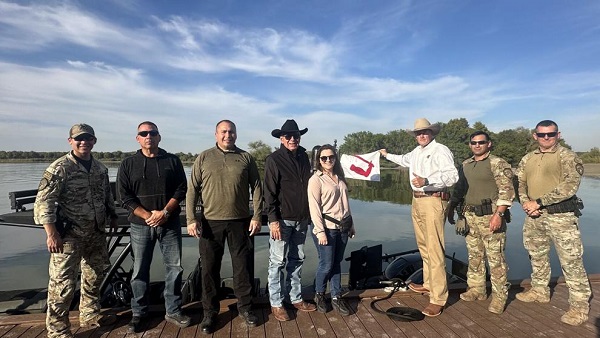
First Nation police chiefs join Texas Department of Public Safety marine units to patrol the Rio Grande River in Hidalgo County, Texas. L-R: Dwayne Zacharie, President of the First Nations Chiefs of Police Association, Ranatiiostha Swamp, Chief of Police of the Akwesasne Mohawk Territory, Brooks County Sheriff Benny Martinez, Jamie Tronnes, Center for North American Prosperity and Security, Goliad County Sheriff Roy Boyd. Photo: Bethany Blankley for The Center Square
From The Center Square
By
Despite Canadian officials arguing that the “Canada-U.S. border is the best-managed and most secure border in the world,” some Canadian groups and First Nation tribal police chiefs disagree.
This week, First Nation representatives traveled to Texas for the first time in U.S.-Canadian history to find ways to implement stronger border security measures at the U.S.-Canada border, including joining an Operation Lone Start Task Force, The Center Square exclusively reported.
Part of the problem is getting law enforcement, elected officials and the general public to understand the reality that Mexican cartels and transnational criminal organizations are operating in Canada; another stems from Trudeau administration visa policies, they argue.
When it comes to public perception, “If you tell Canadians we have a cartel problem, they’ll laugh at you. They don’t believe it. If you tell them we have a gang problem, they will absolutely agree with you 100%. They don’t think that gangs and cartels are the same thing. They don’t see the Hells Angels as equal to the Sinaloa Cartel because” the biker gang is visible, wearing vests out on the streets and cartel operatives aren’t, Jamie Tronnes, executive director of the Center of North American Prosperity and Security, told The Center Square in an exclusive interview.
The center is a US-based project of the MacDonald-Laurier Institute, the largest think tank in Canada. Tronnes previously served as a special assistant to the cabinet minister responsible for immigration and has a background in counterterrorism. She joined First Nation police chiefs to meet with Texas law enforcement and officials this week.
Another Canadian group, Future Borders Coalition, argues, “Canada has become a critical hub for transnational organized crime, with networks operating through its ports, banks, and border communities.” The Sinaloa and Jalisco New Generation Mexican cartels control the fentanyl, methamphetamine and cocaine business in Canada, partnering with local gangs like the Hells Angels and Chinese Communist Party (CCP)-linked actors, who launder profits through casinos, real estate, and shell companies in Vancouver and Toronto, Ammon Blair, a senior fellow at the Texas Public Policy Foundation, and others said at a coalition event prior to First Nation police chiefs and Tronnes coming to Texas.
“The ’Ndrangheta (Italian Mafia) maintains powerful laundering and import operations in Ontario and Quebec, while MS-13 and similar Central American gangs facilitate human smuggling and enforcement. Financial networks tied to Hezbollah and other Middle Eastern groups support laundering and logistics for these criminal alliances,” the coalition reports.
“Together, they form interconnected, technology-driven enterprises that exploit global shipping, cryptocurrency, and AI-enabled communications to traffic whatever yields profit – narcotics, weapons, tobacco, or people. Taking advantage of Canada’s lenient disclosure laws, fragmented jurisdictions, and weak cross-border coordination, these groups have embedded themselves within legitimate sectors, turning Canada into both a transit corridor and safe haven for organized crime,” the coalition reports.
Some First Nation reservations impacted by transnational crime straddle the U.S.-Canada border. One is the Akwesasne Mohawk Reservation, located in Ontario, Quebec, and in two upstate New York counties, where human smuggling and transnational crime is occurring, The Center Square reported. Another is the Tsawwassen First Nation (TWA) Reservation, located in a coastal region south of Vancouver in British Columbia stretching to Point Roberts in Washington state, which operates a ferry along a major smuggling corridor.
Some First Nation reservations like the TWA are suffering from CCP organized crime, Tronnes said. Coastal residents observe smugglers crossing their back yards, going through the reserve; along Canada’s western border, “a lot of fentanyl is being sent out to Asia but it’s also being made in Canada,” Tronnes said.
Transnational criminal activity went largely unchecked under the Trudeau government, during which “border security, national security and national defense were not primary concerns,” Tronnes told The Center Square. “It’s not to say they weren’t concerns, but they weren’t top of mind concerns. The Trudeau government preferred to focus on things like climate change, international human rights issues, a feminist foreign policy type of situation where they were looking more at virtue signaling rather than securing the country.”
Under the Trudeau administration, the greatest number of illegal border crossers, including Canadians, and the greatest number of known, suspected terrorists (KSTs) were reported at the U.S.-Canada border in U.S. history, The Center Square first reported. They include an Iranian with terrorist ties living in Canada and a Canadian woman who tried to poison President Donald Trump, The Center Square reported.
“Had it been a priority for the government to really crack down and provide resources for national security,” federal, provincial and First Nation law enforcement would be better equipped, funded and staffed, Tronnes said. “They would have better ways to understand what’s really happening at the border.”
In February, President Donald Trump for the first time in U.S. history declared a national emergency at the northern border and ordered U.S. military intervention. Months later, his administration acknowledged the majority of fentanyl and KSTs were coming from Canada, The Center Square reported.
Under a new government and in response to pressure from Trump, Canada proposed a $1.3 billion border plan. However, more is needed, the groups argue, including modernizing border technology and an analytics infrastructure, reforming disclosure and privacy rules to enable intelligence sharing, and recognizing and fully funding First Nation police, designating them as essential services and essential to border security.
“National security doesn’t exist without First Nation policing at the border,” Dwayne Zacharie, First Nations Chiefs of Police president, told The Center Square.


Wisdom of Our Elders: The Contempt for Memory in Canadian Indigenous Policy
Liberal bill “targets Christians” by removing religious exemption in hate-speech law

Egypt, Iran ‘completely reject’ World Cup ‘Pride Match’ plan

Canada’s free speech record is cracking under pressure
-
 Energy2 days ago
Tanker ban politics leading to a reckoning for B.C.
-
 Energy2 days ago
Meet REEF — the massive new export engine Canadians have never heard of
-
 Energy15 hours ago
Canada’s future prosperity runs through the northwest coast
-
 Fraser Institute2 days ago
Claims about ‘unmarked graves’ don’t withstand scrutiny
-
 Business2 days ago
Too nice to fight, Canada’s vulnerability in the age of authoritarian coercion
-
 Alberta2 days ago
Here’s why city hall should save ‘blanket rezoning’ in Calgary
-
 Fly Straight - John Ivison1 day ago
MPs who cross the floor are dishonourable members
-
 Business2 days ago
UNDRIP now guides all B.C. laws. BC Courts set off an avalanche of investment risk