
Agriculture
Glimpse into the Future of Food


From the Brownstone Institute

Is your food making you sick?
Suddenly, the fact that food is making us sick, really sick, has gained a lot of attention.
When Robert F. Kennedy, Jr. announced he would suspend his presidential campaign and campaign for President Trump on August 23, both he and Trump spoke about the need to improve the food supply to regain America’s health.
The same week, Tucker Carlson interviewed the sister-brother team of Casey and Calley Means, coauthors of the #1 New York Times bestseller Good Energy: The Surprising Connection Between Metabolism and Limitless Health. Their thesis, borne out by thousands of medical research studies, is that food can make us very healthy or very sick. The grocery store choices many Americans have made have led us to unprecedented levels of diabetes, obesity, and other metabolic and neurologic diseases that prematurely weaken and age us, our organs, and our arteries.
There is a whole lot wrong with our available food.
- Chemical fertilizers have led to abusing the soil, and consequently, soils became depleted of micronutrients. Unsurprisingly, foods grown in them are now lacking those nutrients.
- Pesticides and herbicides harm humans, as well as bugs and weeds.
- Some experts say we need to take supplements now because we can’t get what we need from our foods anymore.
- Subsidies for wheat, corn, and soybean exceed $5 billion annually in cash plus many other forms of support, exceeding $100 billion since 1995, resulting in vast overproduction and centralization.
- We are practically living on overprocessed junk made of sugar, salt, wheat, and seed oils.
And that is just the start. The problem could have been predicted. Food companies grew bigger and bigger, until they achieved virtual monopolies. In order to compete, they had to use the cheapest ingredients. When the few companies left standing banded together, we got industry capture of the agencies that regulated their businesses, turning regulation on its head.
Consolidation in the Meat Industry
Then the regulators issued rules that advantaged the big guys, and disadvantaged the small guys. But it was the small guys who were producing the highest quality food, in most cases. Most of them had to sell out and find something else to do. It simply became uneconomic to be a farmer.
The farmers and ranchers that were left often became the equivalent of serfs on their own land.
Did you know:
- “Ninety-seven percent of the chicken Americans eat is produced by a farmer under contract with a big chicken company. These chicken farmers are the last independent link in an otherwise completely vertically integrated, company-owned supply chain.”
- “Corporate consolidation is at the root of many of the structural ills of our food system. When corporations have the ability to dictate terms to farmers, farmers lose. Corporations place the burden of financial liability on farmers, dictate details of far.”
- ” Corporations also consolidate ownership of the other steps of the supply chain that farmers depend on — inputs, processing, distribution, and marketing — leaving farmers few options but to deal with an entity against which they have effectively no voice or bargaining power.”
When profitability alone, whether assisted by policy or not, determines which companies succeed and which fail, cutting corners is a necessity for American businesses — unless you have a niche food business, or are able to sell directly to consumers. This simple fact inevitably led to a race to the bottom for quality.
Look at the world’s ten largest food companies. Their sales are enormous, but should we really be consuming their products?

Perhaps the regulators could have avoided the debasement of the food supply. But they didn’t.
And now it has become a truism that Americans have the worst diet in the world.
Could food shortages be looming?
If it seems like the US, blessed with abundant natural resources, could never suffer a food shortage, think again. Did you know that while the US is the world’s largest food exporter, in 2023 the US imported more food than we exported?

Cows are under attack, allegedly because their belching methane contributes to climate change. Holland has said it must get rid of 30-50% of its cows. Ireland and Canada are also preparing to reduce the number of their cows, using the same justification.
In the US, the number of cows being raised has gradually lessened, so that now we have the same number of cows that were being raised in 1951 — but the population has increased by 125% since then. We have more than double the people, but the same number of cows. What!? Much of our beef comes from Brazil.
Pigs and chickens are now mostly raised indoors. Their industries are already consolidated to the max. But cows and other ungulates graze for most of their life, and so the beef industry has been unable to be consolidated in the same way.
But consolidation is happening instead in the slaughterhouses because you cannot process beef without a USDA inspector in a USDA-approved facility — and the number of these facilities has been dropping, as have the number of cows they can handle. Four companies now process over 80% of US beef. And that is how the ranchers are being squeezed.
Meanwhile, efforts are afoot to reduce available farmland for both planting crops and grazing animals. Bill Gates is now the #1 owner of US farmland, much of which lies fallow. Solar farms are covering land that used to grow crops — a practice recently outlawed in Italy. Plans are afoot to impose new restrictions on how land that is under conservation easements can be used.
Brave New Food
That isn’t all. The World Economic Forum, along with many governments and multinational agencies, wants to redesign our food supply. So-called plant-based meats, lab-grown meats, “synbio” products, insect protein, and other totally new foods are to replace much of the real meat people enjoy — potentially leading to even greater consolidation of food production. This would allow “rewilding” of grazing areas, allowing them to return to their natural state and, it is claimed, this would be kinder to the planet. But would it?
Much of the land used for grazing is unsuitable for growing crops or for other purposes. The manure of the animals grazing on it replenishes soil nutrients and contributes to the soil microbiome and plant growth. “Rewilding” may in fact lead to the loss of what topsoil is there and desertification of many grazing areas.
Of course, transitioning the food supply to mostly foods coming from factories is a crazy idea, because how can you make a major change in what people eat and expect it to be good for them? What micronutrients are you missing? What will the new chemicals, or newly designed proteins, or even computer-designed DNA (that will inevitably be present in these novel foods) do to us over time? What will companies be feeding the insects they farm, when food production is governed by ever cheaper inputs?
It gets worse. Real food production, by gardeners and small farmers or homesteaders, is decentralized. It cannot be controlled. Until the last 150 years, almost everyone fed themselves from food they caught, gathered, or grew.
But if food comes mainly from factories, access can be cut off. Supply chains can break down. You can be priced out of buying it. Or it could make you sick, and it might take years or generations before the source of the problem is identified. How long has it taken us to figure out that overprocessed foods are a slow poison?
There are some very big problems brewing in the food realm. Whether we like it or not, powerful forces are moving us into the Great Reset, threatening our diet in new ways, ways that most of us never dreamed of.
Identifying the Problems and Solutions
But we can get on top of what is happening, learn what we need to, and we can resist. That’s why Door to Freedom and Children’s Health Defense have unpacked all of these problems and identified possible solutions.
During a jam-packed two-day online symposium, you will learn about all facets of the attack on food, and how to resist. This is an entirely free event, with a fantastic lineup of speakers and topics. Grab a pad and pencil, because you will definitely want to take notes!
The Attack on Food and Farmers, and How to Fight Back premieres on September 6 and 7. It will remain on our channels for later viewing and sharing as well. By the end of Day 2, you will know what actions to take, both in your own backyard, and in the halls of your legislatures to create a healthier, tastier, safer, and more secure food supply.
See below for a summary and for the complete program.


Author


Agriculture
Health Canada indefinitely pauses plan to sell unlabeled cloned meat after massive public backlash

From LifeSiteNews
Health Canada has indefinitely paused its plan to allow unlabeled cloned meat in grocery stores after thousands of Canadians, prominent figures, and industry leaders condemned the move.
Health Canada is pausing its plan to put unlabeled cloned meat in Canadian grocery stores, following public outcry.
In a November 19 update on its website, Health Canada announced an indefinite suspension of the decision to remove labels from cloned meat products after thousands of Canadians condemned the plan online.
“The Government of Canada has received significant input from both consumers and industry about the implications of this potential policy update,” the publication read. “The Department has therefore indefinitely paused the policy update to provide time for further discussions and consideration,” it continued, adding, “Until the policy is updated, foods made from cloned cattle and swine will remain subject to the novel food assessment.”
In late October, Health Canada quietly approved removing labels from foods derived from somatic cell nuclear transfer (SCNT) clones and their offspring. As a result, Canadians buying meat from the grocery store would have had no way of knowing if the product was cloned meat.
Many researchers have documented high rates of cloning failure, large offspring syndrome (LOS), placental abnormalities, early death, and organ defects in cloned animals. The animals are also administered heavy doses of antibiotics due to infections and immune issues.
Typically, the offspring of cloned animals, rather than the cloned animals themselves, are processed for human consumption. As a result, researchers allege that the health defects and high drug use does not affect the final product.
However, there are no comprehensive human studies on the effects of eating cloned meat, meaning that the side-effects for humans are unknown.
News of the plan spread quickly on social media, with thousands of Canadians condemning the plan and promising to switch to local meat providers.
“By authorizing the sale of meat from cloned animals without mandatory labeling or a formal public announcement, Health Canada risks repeating a familiar and costly failure in risk communication. Deeply disappointing,” food policy expert and professor at Dalhousie University Sylvain Charlebois wrote on X.
"By authorizing the sale of meat from cloned animals without mandatory labeling or a formal public announcement, Health Canada risks repeating a familiar and costly failure in risk communication. Deeply disappointing."
More on this week's Food Professor Podcast! https://t.co/UZTIcQzUN3
— The Food Professor (@FoodProfessor) October 30, 2025
Likewise, Conservative MP Leslyn Lewis warned, “Health Canada recently decided that meat from cloned animals and their offspring no longer needs a special review or any form of disclosure.”
“That means, soon you could buy beef or pork and have no idea how it was bred,” she continued. “Other countries debate this openly: the EU has considered strict labelling, and even the U.S. has admitted that cloned-offspring meat is circulating.”
“But here in Canada, the public wasn’t even told. This is about informed choice,” Lewis declared. “If government and industry don’t have to tell us when meat comes from cloned animals, then Canadians need to ask a simple, honest question: What else are we not being told?”
Health Canada recently decided that meat from cloned animals and their offspring no longer needs a special review or any form of disclosure. That means, soon you could buy beef or pork and have no idea how it was bred.
Other countries debate this openly: the EU has considered… pic.twitter.com/zCnqJOpvf3
— Dr. Leslyn Lewis (@LeslynLewis) November 14, 2025
Likewise, duBreton, a leading North American supplier of organic pork based out of Quebec, denounced the move, saying, “Canadians expect clarity, transparency, and meaningful consultation on issues that directly touch their food supply. As producers, we consider it our responsibility and believe our governing food authorities should too.”
According to a survey conducted by duBreton, 74 percent of Canadians believe that “cloned meat and genetic editing practices have no place in farm and food systems.”
Agriculture
Federal cabinet calls for Canadian bank used primarily by white farmers to be more diverse

From LifeSiteNews
A finance department review suggested women, youth, Indigenous, LGBTQ, Black and racialized entrepreneurs are underserved by Farm Credit Canada.
The Cabinet of Prime Minister Mark Carney said in a note that a Canadian Crown bank mostly used by farmers is too “white” and not diverse enough in its lending to “traditionally underrepresented groups” such as LGBT minorities.
Farm Credit Canada Regina, in Saskatchewan, is used by thousands of farmers, yet federal cabinet overseers claim its loan portfolio needs greater diversity.
The finance department note, which aims to make amendments to the Farm Credit Canada Act, claims that agriculture is “predominantly older white men.”
Proposed changes to the Act mean the government will mandate “regular legislative reviews to ensure alignment with the needs of the agriculture and agri-food sector.”
“Farm operators are predominantly older white men and farm families tend to have higher average incomes compared to all Canadians,” the note reads.
“Traditionally underrepresented groups such as women, youth, Indigenous, LGBTQ, and Black and racialized entrepreneurs may particularly benefit from regular legislative reviews to better enable Farm Credit Canada to align its activities with their specific needs.”
The text includes no legal amendment, and the finance department did not say why it was brought forward or who asked for the changes.
Canadian census data shows that there are only 590,710 farmers and their families, a number that keeps going down. The average farmer is a 55-year-old male and predominantly Christian, either Catholic or from the United Church.
Data shows that 6.9 percent of farmers are immigrants, with about 3.7 percent being “from racialized groups.”
National census data from 2021 indicates that about four percent of Canadians say they are LGBT; however, those who are farmers is not stated.
Historically, most farmers in Canada are multi-generational descendants of Christian/Catholic Europeans who came to Canada in the mid to late 1800s, mainly from the United Kingdom, Ireland, Ukraine, Russia, Italy, Poland, the Netherlands, Germany, and France.


Canadians will soon be versed in massive West Coast LPG mega-project

Keynote address of Premier Danielle Smith at 2025 UCP AGM

Canada Needs an Alternative to Carney’s One Man Show

Net Zero goal is a fundamental flaw in the Ottawa-Alberta MOU
-
 Alberta2 days ago
This new Canada–Alberta pipeline agreement will cost you more than you think
-
 Energy2 days ago
Unceded is uncertain
-
 Automotive2 days ago
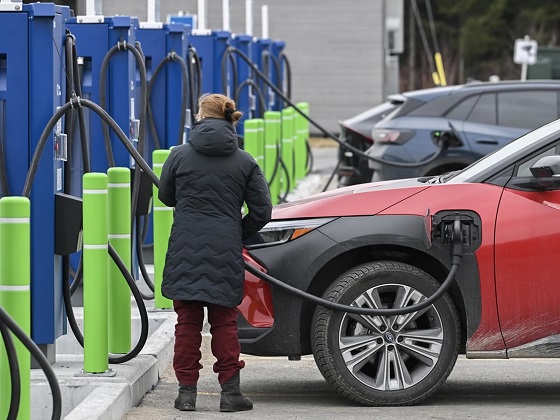
Power Struggle: Governments start quietly backing away from EV mandates
-
 Energy1 day ago
Canada following Europe’s stumble by ignoring energy reality
-
 Business1 day ago
Canada’s climate agenda hit business hard but barely cut emissions
-
 MAiD2 days ago
From Exception to Routine. Why Canada’s State-Assisted Suicide Regime Demands a Human-Rights Review
-
 International11 hours ago
FBI may have finally nabbed the Jan. 6 pipe bomber
-
 Business1 day ago
Carney government should privatize airports—then open airline industry to competition