
National
Former Saskatchewan Premier Brad Wall on working with (or against) Justin Trudeau


From a FaceBook post by former Saskatchewan Premier Brad Wall


From the Frontier Centre for Public Policy
By Lee Harding
Ottawa says Bill C-9 fights hate. Critics say it turns ordinary disagreement into a potential crime.
Discriminatory hate is not a good thing. Neither, however, is the latest bill by the federal Liberal government meant to fight it. Civil liberties organizations and conservative commentators warn that Bill C-9 could do more to chill legitimate speech than curb actual hate.
Bill C-9 creates a new offence allowing up to life imprisonment for acts motivated by hatred against identifiable groups. It also creates new crimes for intimidation or obstruction near places of worship or community buildings used by identifiable groups. The bill adds a new hate propaganda offence for displaying terrorism or hate symbols.
The Canadian Civil Liberties Association (CCLA) warns the legislation “risks criminalizing some forms of protected speech and peaceful protest—two cornerstones of a free and democratic society—around tens of thousands of community gathering spaces in Canada.” The CCLA sees no need to add to existing hate laws.
Bill C-9 also removes the requirement that the Attorney General consent to lay charges for existing hate propaganda offences. The Canadian Constitution Foundation (CCF) calls this a major flaw, noting it removes “an important safeguard for freedom of expression that has been part of Canada’s law for decades.” Without that safeguard, decisions to prosecute may depend more on local political pressures and less on consistent national standards.
Strange as it sounds, hatred just will not be what it used to be if this legislation passes. The core problem begins with how the bill redefines the term itself.
Previously, the Supreme Court of Canada said hatred requires “extreme manifestations” of detestation or vilification that involve destruction, abhorrence or portraying groups as subhuman or innately evil. Instead, Bill C-9 defines hatred as “detestation or vilification,” stronger than “disdain or dislike.” That is a notably lower threshold. This shift means that ordinary political disagreement or sharp criticism could now be treated as criminal hatred, putting a wide range of protected expression at real risk.
The bill also punishes a hateful motivation more than the underlying crime. For example, if a criminal conviction prompted a sentence of two years to less than five years, a hateful motivation would add as much as an additional five years of jail time.
On paper, most Canadians may assume they will never be affected by these offences. In practice, the definition of “hate” is already stretched far beyond genuine threats or violence.
Two years ago, the 1 Million March for Children took place across Canada to protest the teaching of transgender concepts to schoolchildren, especially the very young. Although such opposition is a valid position, unions, LGBT advocates and even Newfoundland and Labrador Conservatives adopted the “No Space For Hate” slogan in response to the march. That label now gets applied far beyond real extremism.
Public pressure also shapes how police respond to protests. If citizens with traditional values protest a drag queen story hour near a public library, attendees may demand that police lay charges and accuse officers of implicit hatred if they refuse. The practical result is clear: officers may feel institutional pressure to lay charges to avoid being accused of bias, regardless of whether any genuine threat or harm occurred.
Police, some of whom take part in Pride week or work in stations decorated with rainbow colours in June, may be wary of appearing insensitive or intolerant. There have also been cases where residents involved in home invasion incidents were charged, and courts later determined whether excessive force was used. In a similar way, officers may lay charges first and allow the courts to sort out whether a protest crossed a line. Identity-related considerations are included in many workplace “sensitivity training” programs, and these broader cultural trends may influence how such situations are viewed. In practice, this could mean that protests viewed as ideologically unfashionable face a higher risk of criminal sanction than those aligned with current political priorities.
If a demonstrator is charged and convicted for hate, the Liberal government could present the prosecution as a matter for the justice system rather than political discretion. It may say, “It was never our choice to charge or convict these people. The system is doing its job. We must fight hate everywhere.”
Provincial governments that support prosecution will be shielded by the inability to show discretion, while those that would prefer to let matters drop will be unable to intervene. Either way, the bill could increase tensions between Ottawa and the provinces. This could effectively centralize political authority over hate-related prosecutions in Ottawa, regardless of regional differences in values or enforcement priorities.
The bill also raises concerns about how symbols are interpreted. While most Canadians would associate the term “hate symbol” with a swastika, some have linked Canada’s former flag to extremism. The Canadian Anti-Hate Network did so in 2022 in an educational resource entitled “Confronting and preventing hate in Canadian schools.”
The flag, last used nationally in 1965, was listed under “hate-promoting symbols” for its alleged use by the “alt-right/Canada First movement” to recall when Canada was predominantly white. “Its usage in modern times is an indicator of hate-promoting beliefs,” the resource insisted. If a historic Canadian symbol can be reclassified this easily, it shows how subjective and unstable the definition of a “hate symbol” could become under this bill.
These trends suggest the legislation jeopardizes not only symbols associated with Canada’s past, but also the values that supported open debate and free expression. Taken together, these changes do not merely target hateful behaviour. They create a legal framework that can be stretched to police dissent and suppress unpopular viewpoints. Rest in peace, free speech.
Lee Harding is a research fellow for the Frontier Centre for Public Policy.
From LifeSiteNews
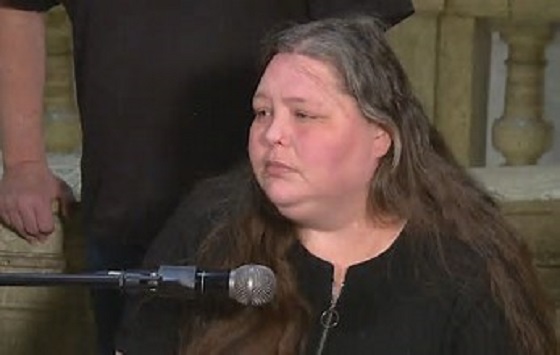
Jolene Van Alstine, approved for state-sanctioned euthanasia after enduring long wait times to receive care for a rare parathyroid disease, is in need of a passport to enter the U.S.
Well-known American media personality Glenn Beck says he has been in touch with the U.S. State Department to help a Canadian woman in Saskatchewan reconsider euthanasia after she sought assisted suicide due to long medical wait times to address her health problems.
As reported by LifeSiteNews on Tuesday, Canadian woman Jolene Van Alstine was approved to die by state-sanctioned euthanasia because she has had to endure long wait times to get what she considers to be proper care for a rare parathyroid disease.
Van Alstine’s condition, normocalcemic primary hyperparathyroidism (nPHPT), causes her to experience vomiting, nausea, and bone pain.
Her cause caught the attention of Beck and many other prominent Americans and Canadians on X.
In an update today on X, Beck said, “Jolene does not have a passport to gain legal entry into the U.S., but my team has been in touch with President (Donald) Trump’s State Department.”
“All I can say for now is they are aware of the urgent life-saving need, and we had a very positive call,” he added.
Beck had said before that he was in “contact with Jolene and her husband” and that he had “surgeons who emailed us standing by to help her.”
As of press time, neither the State Department nor other officials have not yet confirmed Beck’s claim that he has been in touch with them.
As a result of Van Alstine’s frustrations with the healthcare system, she applied for Canada’s Medical Assistance in Dying (MAiD) and was approved for January 7.
As reported by LifeSiteNews, over 23,000 Canadians have died while on wait lists for medical care as Prime Minister Mark Carney’s Liberal government is focused on euthanasia expansions.
A new Euthanasia Prevention Coalition report revealed that Canada has euthanized 90,000 people since 2016, the year it was legalized.
As reported by LifeSiteNews recently, a Conservative MP’s private member’s bill that, if passed, would ban euthanasia for people with mental illness received the full support of the Euthanasia Prevention Coalition.


Trump Deals Biden’s EV Dreams A Death Blow
Liberal bill “targets Christians” by removing religious exemption in hate-speech law

Wisdom of Our Elders: The Contempt for Memory in Canadian Indigenous Policy

Canada invests $34 million in Chinese drones now considered to be ‘high security risks’
-
C2C Journal23 hours ago
Wisdom of Our Elders: The Contempt for Memory in Canadian Indigenous Policy
-
 Business2 days ago
Conservative MP warns Liberals’ national AI plan could increase gov’t surveillance
-
 Business2 days ago
Looks like the Liberals don’t support their own Pipeline MOU
-
 Sports20 hours ago
Egypt, Iran ‘completely reject’ World Cup ‘Pride Match’ plan
-
 Alberta22 hours ago
Alberta introducing three “all-season resort areas” to provide more summer activities in Alberta’s mountain parks
-
 Business2 days ago
Canada Can Finally Profit From LNG If Ottawa Stops Dragging Its Feet
-
 Business1 day ago
Storm clouds of uncertainty as BC courts deal another blow to industry and investment
-
 Alberta2 days ago
They never wanted a pipeline! – Deputy Conservative Leader Melissa Lantsman