Connect with us
[bsa_pro_ad_space id=12]

Uncategorized

Firm tied to voter registration ‘scheme’ goes dark

Published

5 minute read

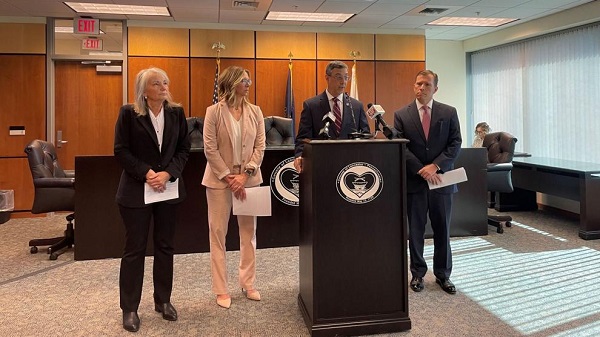
From left, Lancaster County Commissioner Alice Yoder, Lancaster County District Attorney Heather Adams, Commissioners Ray D’Agostino and Josh Parsons. The officials held a press conference on Friday, Oct. 25, 2024, to discuss voter registration fraud detected in the county.

From The Center Square

By 

Everybody Votes runs an office in Lancaster County, where election workers recently found suspicious registration forms among a batch of 2,500 applications delivered last week. Investigators there said at least 60% of those reviewed were fraudulent.

The media and consulting firm linked to fraudulent voter registration forms in Pennsylvania earlier this week has gone dark as of Saturday.

Field and Media Corps – the website and social media accounts of which are now defunct – is an Arizona-based company that contracts with Everybody Votes to run a canvassing operation in Pennsylvania and other states that target low-income minority residents unregistered to vote.

The Monroe County District Attorney’s Office confirmed Wednesday that 30 registration forms contained fraudulent information, including an application submitted on behalf of a dead resident.

Everybody Votes runs an office in Lancaster County, where election workers recently found suspicious registration forms among a batch of 2,500 applications delivered last week. Investigators there said at least 60% of those reviewed were fraudulent. So far, the campaign has not been tied directly to the investigation.

Not so in nearby York County, where law enforcement continues reviewing another delivery from the operation leading up to the Oct. 22 deadline to register.

On Wednesday, the America First Policy Institute, a conservative-leaning research nonprofit,  demanded a federal investigation into the company.

“Where there’s fire, there’s fire,” said Hogan Gidley, vice chairman of the institute’s Center for Election Integrity. “Thousands of instances of reported voter registration fraud have now been confirmed throughout Pennsylvania.”

He described Field and Media Corps, established in 2017, as a “high-powered left-wing organization” that may have launched similar “schemes” across the country that require state-level investigations.

“Submitting fraudulent registrations right at the voter deadline to overwhelm election officials is exactly the kind of scheme that the Department of Justice should be using their force and resources to stop,” he said.

Evidence also exists that Everybody Votes is linked to a left-wing super political action committee intent on expanding registration numbers for Democrats in battleground states.

According to public tax records shared with The Center Square, The Voter Registration Project, also known as Everybody Votes, describes itself as a public charity that helps low-income minority citizens register to vote and provides technical assistance to voter registration drives.

The organization reported $45.8 million in total revenues in 2022, a “substantial portion of which comes from a governmental unit or the general public.”

A 2023 report from Capital Research Center, a conservative nonprofit, says left-wing donors together raised $190 million for the campaign to register 5.1 million voters across the country – all in violation of federal law that bars 501(c)(3) from engaging in such activity.

The strategy, detailed in a 2019 leaked memo from Mind the Gap, the liberal super PAC in question, entices investors by promising a more cost-effective strategy to boost vote counts for Democrats – namely through voter registration drives.

The group pointed to its direct role in flipping the U.S. House blue in 2018 as “proof of concept.”

Detailed further in the report are signed tax forms from donors that link their grants to the Voter Registration Project in direct support of Mind the Gap. The Capital Research Center estimates President Joe Biden collected between 1 million and 2.7 million swing state votes in the 2020 election as a result.

Biden defeated then-incumbent President Donald Trump 306-232 in electoral college votes; the popular vote was Biden 81.2 million to 74.2 million.

Francisco Heredia, who runs Field and Media Corps, told Votebeat earlier this week he’d not heard from county officials in Pennsylvania, but would cooperate with the investigation. He said the company trains workers how to legally complete registration forms and has no tolerance for fraud.

Todayville is a digital media and technology company. We profile unique stories and events in our community. Register and promote your community event for free.

Follow Author

Uncategorized

Mortgaging Canada’s energy future — the hidden costs of the Carney-Smith pipeline deal

Published on

CAE Logo
By Dan McTeague

Much of the commentary on the Carney-Smith pipeline Memorandum of Understanding (MOU) has focused on the question of whether or not the proposed pipeline will ever get built.

That’s an important topic, and one that deserves to be examined — whether, as John Robson, of the indispensable Climate Discussion Nexus, predicted, “opposition from the government of British Columbia and aboriginal groups, and the skittishness of the oil industry about investing in a major project in Canada, will kill [the pipeline] dead.”

But I’m going to ask a different question: Would it even be worth building this pipeline on the terms Ottawa is forcing on Alberta? If you squint, the MOU might look like a victory on paper. Ottawa suspends the oil and gas emissions cap, proposes an exemption from the West Coast tanker ban, and lays the groundwork for the construction of one (though only one) million barrels per day pipeline to tidewater.

But in return, Alberta must agree to jack its industrial carbon tax up from $95 to $130 per tonne at a minimum, while committing to tens of billions in carbon capture, utilization, and storage (CCUS) spending, including the $16.5 billion Pathways Alliance megaproject.

Here’s the part none of the project’s boosters seem to want to mention: those concessions will make the production of Canadian hydrocarbon energy significantly more expensive.

As economist Jack Mintz has explained, the industrial carbon tax hike alone adds more than $5 USD per barrel of Canadian crude to marginal production costs — the costs that matter when companies decide whether to invest in new production. Layer on the CCUS requirements and you get another $1.20–$3 per barrel for mining projects and $3.60–$4.80 for steam-assisted operations.

While roughly 62% of the capital cost of carbon capture is to be covered by taxpayers — another problem with the agreement, I might add — the remainder is covered by the industry, and thus, eventually, consumers.

Total damage: somewhere between $6.40 and $10 US per barrel. Perhaps more.

“Ultimately,” the Fraser Institute explains, “this will widen the competitiveness gap between Alberta and many other jurisdictions, such as the United States,” that don’t hamstring their energy producers in this way. Producers in Texas and Oklahoma, not to mention Saudi Arabia, Venezuela, or Russia, aren’t paying a dime in equivalent carbon taxes or mandatory CCUS bills. They’re not so masochistic.

American refiners won’t pay a “low-carbon premium” for Canadian crude. They’ll just buy cheaper oil or ramp up their own production.

In short, a shiny new pipe is worthless if the extra cost makes barrels of our oil so expensive that no one will want them.

And that doesn’t even touch on the problem for the domestic market, where the higher production cost will be passed onto Canadian consumers in the form of higher gas and diesel prices, home heating costs, and an elevated cost of everyday goods, like groceries.

Either way, Canadians lose.

So, concludes Mintz, “The big problem for a new oil pipeline isn’t getting BC or First Nation acceptance. Rather, it’s smothering the industry’s competitiveness by layering on carbon pricing and decarbonization costs that most competing countries don’t charge.” Meanwhile, lurking underneath this whole discussion is the MOU’s ultimate Achilles’ heel: net-zero.

The MOU proudly declares that “Canada and Alberta remain committed to achieving Net-Zero greenhouse gas emissions by 2050.” As Vaclav Smil documented in a recent study of Net-Zero, global fossil-fuel use has risen 55% since the 1997 Kyoto agreement, despite trillions spent on subsidies and regulations. Fossil fuels still supply 82% of the world’s energy.

With these numbers in mind, the idea that Canada can unilaterally decarbonize its largest export industry in 25 years is delusional.

This deal doesn’t secure Canada’s energy future. It mortgages it. We are trading market access for self-inflicted costs that will shrink production, scare off capital, and cut into the profitability of any potential pipeline. Affordable energy, good jobs, and national prosperity shouldn’t require surrendering to net-zero fantasy.If Ottawa were serious about making Canada an energy superpower, it would scrap the anti-resource laws outright, kill the carbon taxes, and let our world-class oil and gas compete on merit. Instead, we’ve been handed a backroom MOU which, for the cost of one pipeline — if that! — guarantees higher costs today and smothers the industry that is the backbone of the Canadian economy.

This MOU isn’t salvation. It’s a prescription for Canadian decline.

Continue Reading

Uncategorized

Cost of bureaucracy balloons 80 per cent in 10 years: Public Accounts

Published on

By Franco Terrazzano 

The cost of the bureaucracy increased by $6 billion last year, according to newly released numbers in Public Accounts disclosures. The Canadian Taxpayers Federation is calling on Prime Minister Mark Carney to immediately shrink the bureaucracy.

“The Public Accounts show the cost of the federal bureaucracy is out of control,” said Franco Terrazzano, CTF Federal Director. “Tinkering around the edges won’t cut it, Carney needs to take urgent action to shrink the bloated federal bureaucracy.”

The federal bureaucracy cost taxpayers $71.4 billion in 2024-25, according to the Public Accounts. The cost of the federal bureaucracy increased by $6 billion, or more than nine per cent, over the last year.

The federal bureaucracy cost taxpayers $39.6 billion in 2015-16, according to the Public Accounts. That means the cost of the federal bureaucracy increased 80 per cent over the last 10 years. The government added 99,000 extra bureaucrats between 2015-16 and 2024-25.

Half of Canadians say federal services have gotten worse since 2016, despite the massive increase in the federal bureaucracy, according to a Leger poll.

Not only has the size of the bureaucracy increased, the cost of consultants, contractors and outsourcing has increased as well. The government spent $23.1 billion on “professional and special services” last year, according to the Public Accounts. That’s an 11 per cent increase over the previous year. The government’s spending on professional and special services more than doubled since 2015-16.

“Taxpayers should not be paying way more for in-house government bureaucrats and way more for outside help,” Terrazzano said. “Mere promises to find minor savings in the federal bureaucracy won’t fix Canada’s finances.

“Taxpayers need Carney to take urgent action and significantly cut the number of bureaucrats now.”

Table: Cost of bureaucracy and professional and special services, Public Accounts

Year Bureaucracy Professional and special services

2024-25

$71,369,677,000

$23,145,218,000

2023-24

$65,326,643,000

$20,771,477,000

2022-23

$56,467,851,000

$18,591,373,000

2021-22

$60,676,243,000

$17,511,078,000

2020-21

$52,984,272,000

$14,720,455,000

2019-20

$46,349,166,000

$13,334,341,000

2018-19

$46,131,628,000

$12,940,395,000

2017-18

$45,262,821,000

$12,950,619,000

2016-17

$38,909,594,000

$11,910,257,000

2015-16

$39,616,656,000

$11,082,974,000

Continue Reading

Trending

X