
MAiD
Even Canadian leftists are starting to recognize the ‘dystopian’ nature of MAiD


From LifeSiteNews
Euthanasia based on poverty or disability is rarely based on personal choice and autonomy, it is horrifying, it is profane, it is the outcome of a failed social welfare system, and it is indefensible.
David Moscrop wrote an excellent article that was published by Jacobin Magazine on May 2, 2024. Jacobin is an ideologically left magazine, which is concerned about Canada killing people with disabilities and the poor by euthanasia, known as MAiD (Medical Assistance in Dying).
The article begins with this quote:
Canada boasts one of the world’s highest assisted-death rates, supposedly enabling the terminally ill to die with dignity. However, this suicide program increasingly resembles a dystopian replacement for care services, exchanging social welfare for euthanasia.
Moscrop tells the story of Normand Meunier, the quadriplegic man in Québec who died by euthanasia after suffering from horrific neglect. Moscrop writes:
For want of a mattress, a man is dead. That’s the story, in sum, of a quadriplegic man who chose to end his life in January through medically assisted death. Normand Meunier’s story, as reported by the CBC, began with a visit to a Quebec hospital due to a respiratory virus. Meunier subsequently developed a painful bedsore after being left without access to a mattress to accommodate his needs. Thereafter, he applied to Canada’s Medical Assistance in Dying (MAiD) program.
As Rachel Watts writes in her report, Meunier spent ninety-five hours on a stretcher in the emergency room – just hours short of four days. The bedsore he developed ‘eventually worsened to the point where bone and muscle were exposed and visible – making his recovery and prognosis bleak.’ The man who ‘didn’t want to be a burden’ chose to die at home. An internal investigation into the matter is underway.
I find it interesting that the article states that Meunier chose to die by euthanasia when in fact he was put into an untenable situation. Moscrop then reinforces the concerns of the disability community:
Disability and other advocates have been warning us for years that MAiD puts people at risk. They warned that the risk of people choosing death – because it’s easier than fighting to survive in a system that impoverishes people, and disproportionately does so to those who are disabled – is real. Underinvestment in medical care will push people up to and beyond the brink, which means some will choose to die instead of ‘burden’ their loved ones or society at large. They were right.
Moscrop comments on how euthanasia is the outcome of a failed social welfare state:
A libertarian ethos partially underwrote the fact that not many people blinked when MAiD was initially rolled out. Taking a more expansive view of rights, many of those not swayed by rote libertarianism were convinced that concerns over bodily autonomy and compassion were reason enough to adopt MAiD. However, in the absence of a robust welfare state, and in the face of structural poverty and discrimination, particularly toward disabled people, there is no world in which the MAiD program can be understood to be ‘progressive.’
Indeed, last year, Jeremy Appel argued that MAiD was ‘beginning to look like a dystopian end run around the cost of providing social welfare.’ Initially supportive, he changed his mind on MAiD as he considered that the decisions people make are not strictly speaking individual but are instead collectively shaped and sometimes ‘the product of social circumstances, which are outside of their control.’ When we don’t care for one another, what do we end up with?
‘I’ve come to realize,’ wrote Appel, ‘that euthanasia in Canada represents the cynical endgame of social provisioning with the brutal logic of late-stage capitalism – we’ll starve you of the funding you need to live a dignified life [. . .] and if you don’t like it, why don’t you just kill yourself?’
READ: Young, healthy women being euthanized in the Netherlands should be a warning for Canada
Moscrop then comments on that euthanasia for psychiatric reasons has been delayed in Canada based on the lack of mental health care. He refers to the reality as grotesque and writes that this is the stuff of nightmarish science fiction. Moscrop comments on the broken social welfare system in Canada.
In Canada’s most populous province, Ontario, a recipient of disability support receives about $1,300 a month – a pittance they’re meant to stretch to cover food, shelter, and other basic needs. Ontario Works – the province’s welfare program – pays a current maximum of $733 a month. Meanwhile, rental costs for a one bedroom apartment routinely push toward an average of $2,000 a month in many cities. In April, in Toronto, a one bedroom apartment averaged almost $2,500 a month.
Moscrop challenges a statement by euthanasia activists James Downer and Susan MacDonald who stated:
Despite fears that availability of MAiD for people with terminal illness would lead to requests for MAiD driven by socioeconomic deprivation or poor service availability (e.g., palliative care), available evidence consistently indicates that MAiD is most commonly received by people of high socioeconomic status and lower support needs, and those with high involvement of palliative care.
Moscrop replies:
By their own admission, the data on this matter is imperfect. But even if it were, the fact that ‘most’ patients who choose MAiD are better off socioeconomically is beside the point. Some are not – and those ‘some’ are important. That includes a man living with Amyotrophic Lateral Sclerosis who, in 2019, chose medically assisted death because he couldn’t find adequate medical care that would also allow him to be with his son. It also includes a man whose application listed only ‘hearing loss,’ and whose brother says he was ‘basically put to death.’ This story came a year after experts raised the concern that the country’s MAiD regime was in violation of the Universal Declaration of Human Rights.
In 2022, Global News said the quiet part out loud: poverty is driving disabled Canadians to consider MAiD. Those ‘some’ who are driven to assisted death because of poverty or an inability to access adequate care deserve to live with dignity and with the resources they need to live as they wish. They should never, ever feel the pressure to choose to die because our social welfare institutions are starved and our health care system has been vandalized through years of austerity and poor management.
Moscrop then states that Canada has the resources to prevent endemic poverty and provide adequate care, that poor people being euthanized by the state is profane.
Moscrop then refers to a recent article by professor Trudo Lemmens who is a critic of Canada’s euthanasia law.
In a February piece for the Globe and Mail, University of Toronto law professor Trudo Lemmens wrote, ‘The results of our MAiD regime’s promotion of access to death as a benefit, and the trivialization of death as a harm to be protected against, are increasingly clear.’ In critiquing MAiD’s second track, which allows physician-assisted death for those who do not face ‘a reasonably foreseeable death,’ Lemmens points out that within two years of its adoption, ‘“track two”’ MAiD providers had ended already the lives of close to seven hundred disabled people, most of whom likely had years of life left.’
In raising concerns about expanding MAiD to cover mental illness, Lemmens added that ‘there are growing concerns that inadequate social and mental health care, and a failure to provide housing supports, push people to request MAiD,’ noting that ‘[a]dding mental illness as a basis for MAiD will only increase the number of people exposed to higher risks of premature death.’
Moscrop continues by referring to a commentary from disability leader Gabrielle Peters.
In 2021, Gabrielle Peters warned in Maclean’s that extending MAiD to cover those who weren’t facing an immediately foreseeable death was ‘dangerous, unsettling and deeply flawed.’ She traced the various ways in which a broader MAiD law could lead to people choosing to die in the face of austerity, adding an intersectional lens that is often missing from our discussions and debates over the issue.
She warned that we were failing to consider ‘how poverty and racism intersect with disability to create greater risk of harm, more institutional bias and barriers, additional layers of othering and dehumanization, and fewer resources for addressing any of these.’ And now here we are. We should have listened more carefully.
Moscrop ends his article by suggesting that euthanasia may be OK based on personal choice but it is indefensible when it is based on poverty.
While MAiD may be defensible as a means for individuals to exercise personal choice in how they live and how they die when facing illness and pain, it is plainly indefensible when state-induced austerity and mismanagement leads to people choosing to end their lives that have been made unnecessarily miserable. In short, we are killing people for being poor and disabled, which is horrifying.
It thus falls to proponents of MAiD to show how such deaths can be avoided, just as it falls to policymakers to build or rebuild institutions that ensure no one ever opts to end their life for lack of resources or support, which we could provide in abundance if we choose to.
I agree with most of Moscrop’s comments but I disagree with his statement that euthanasia is possibly defensible as a means of individuals exercising personal choice. Even though people with disabilities experience social devaluation in Canada, they may be still exercising personal choice when they ask to be killed.
The problem with modern writers is that they miss the fact that euthanasia is about killing people. Even if Canada had a greater level of equality, there would be people who ask to be killed based on their poverty or their concerns about homelessness.
The real concern is that Canada has given medical professionals the right in law to kill their patients. This is about people killing people.
Nonetheless Moscrop is right that euthanasia based on poverty or disability is rarely based on personal choice and autonomy, it is horrifying, it is profane, it is the outcome of a failed social welfare system, and it is indefensible.
Reprinted with permission from the Euthanasia Prevention Coalition.


From LifeSiteNews
Karly Vavra, the little girl’s mother, told People that she chose to share the video in order to honor her grandfather—but also to normalize euthanasia.
A video of a 7-year-old girl sharing a “final cuddle” with her great-grandfather before he is euthanized has gone viral on TikTok, racking up millions of views.
@karlsbergggg Sobbing 😭 #MAID #medicallyassisteddeath #grandpasgirl #greatgrandpa #greatgrandparents
The video shows the child curled up next to an elderly man, sitting straight on the couch, their final moments together captured. “This is my 96 year old grandpa with my 7 year old,” the caption reads. “He’s doing MAID soon. I tried explaining gently to my daughter that this was the last visit she’d have with him. This is what she did the second she walked in. He’s so happy.”
Karly Vavra, the little girl’s mother, told People that she chose to share the video in order to honor her grandfather—but also to normalize euthanasia. “The feeling is very bittersweet,” she said. “I look back with smiles and tears.” She admitted that she knows “my daughter didn’t fully understand these were her last moments with him.”
Her grandfather, who had chosen euthanasia, did understand the gravity of the moment. “My grandpa knew those were his last moments with her,” Vavra said. “Him looking down in that short moment, I believe, was his way of trying to hide emotions as he was a very proud man.” Her grandfather was scheduled to be killed by lethal injection just days later.
READ: Glenn Beck offers to fund life-saving surgery for Canadian woman approved for euthanasia
Vavra says her grandfather was always a favorite of neighborhood children, who were drawn to him. “I am so grateful both my kids got to know him, though, as not many children get [much] time, if any, with a great grandparent,” she said. “My grandpa was honestly the sweetest man. He loved children, gardening, golf, music and was VERY opinionated… Him and my kids were always laughing with each other, and he loved how loud and proud my daughter was! I hope she is strong like he was and always laughs and sees the brighter side.”
Vavra posted the video because she wanted to celebrate her grandfather’s euthanasia. “I posted this because I truly believe MAID can be a wonderful thing,” she told People. “Letting people go the way they want, with dignity, and not suffering… A lot of religions don’t believe in MAID and some comments were more aggressive than others. Seeing how negative some of the responses were made me really want to advocate for the MAID program.”
“Her connection to MAID began long before her own grandparents made their decisions, as she previously worked on a case in British Columbia after she says many of her coworkers opted not to participate,” People reported.
“I am a very open, understanding person and believe in ‘your body your choice’ which is why I volunteered,” she says...This year alone brought unimaginable loss for her family. “My parents and aunt have had a harder time because both their mom and dad decided to do MAID this year, so it’s definitely been a rough year, but we are sticking together as a family and really trying to cherish all our moments together,” Karly shares.
There are over 10,000 comments on Vavra’s TikTok video, many of them expressing horror at the normalization of putting elderly people to sleep like sick household pets.
“I always try to be honest with my children,” Vavra said. “I explained that Big Papa (what my kids called him) was in a lot of pain and that he would be going to meet Big Grandma on Saturday (my grandma also did MAID this year). I explained that a very nice doctor and nurses were coming and they were going to give him some medicine and he would fall into the best sleep ever but forever, and that he wouldn’t be in pain anymore.”
It is notable that despite the irreligious basis of euthanasia, spiritual language is often incorporated into euthanasia conversations in order to soften the reality of what is taking place.
This is a new Canadian reality: Children losing their parents, grandparents, and great-grandparents not to natural death, but to lethal injections. Their goodbyes are defined by moments that do not have to be the last but have been chosen. There could have been more conversations. More cuddles. More love. But there was not—and that was a decision. “Seeing her link arms with him was very touching but of course very painful,” Vavra said. “Both loving each other so much. I wish we could have had him forever.”
They could have had him longer.

From LifeSiteNews
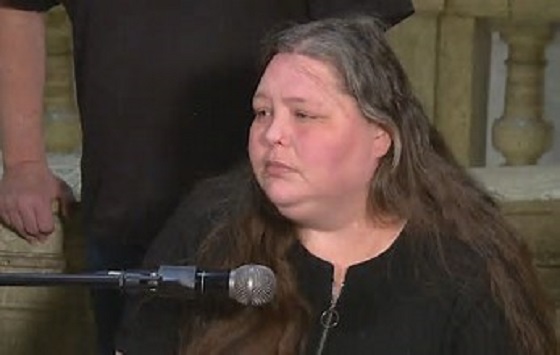
Jolene Van Alstine, approved for state-sanctioned euthanasia after enduring long wait times to receive care for a rare parathyroid disease, is in need of a passport to enter the U.S.
Well-known American media personality Glenn Beck says he has been in touch with the U.S. State Department to help a Canadian woman in Saskatchewan reconsider euthanasia after she sought assisted suicide due to long medical wait times to address her health problems.
As reported by LifeSiteNews on Tuesday, Canadian woman Jolene Van Alstine was approved to die by state-sanctioned euthanasia because she has had to endure long wait times to get what she considers to be proper care for a rare parathyroid disease.
Van Alstine’s condition, normocalcemic primary hyperparathyroidism (nPHPT), causes her to experience vomiting, nausea, and bone pain.
Her cause caught the attention of Beck and many other prominent Americans and Canadians on X.
In an update today on X, Beck said, “Jolene does not have a passport to gain legal entry into the U.S., but my team has been in touch with President (Donald) Trump’s State Department.”
“All I can say for now is they are aware of the urgent life-saving need, and we had a very positive call,” he added.
Beck had said before that he was in “contact with Jolene and her husband” and that he had “surgeons who emailed us standing by to help her.”
As of press time, neither the State Department nor other officials have not yet confirmed Beck’s claim that he has been in touch with them.
As a result of Van Alstine’s frustrations with the healthcare system, she applied for Canada’s Medical Assistance in Dying (MAiD) and was approved for January 7.
As reported by LifeSiteNews, over 23,000 Canadians have died while on wait lists for medical care as Prime Minister Mark Carney’s Liberal government is focused on euthanasia expansions.
A new Euthanasia Prevention Coalition report revealed that Canada has euthanized 90,000 people since 2016, the year it was legalized.
As reported by LifeSiteNews recently, a Conservative MP’s private member’s bill that, if passed, would ban euthanasia for people with mental illness received the full support of the Euthanasia Prevention Coalition.


Terror in Australia: 12 killed after gunmen open fire on Hanukkah celebration

Tanker ban politics leading to a reckoning for B.C.

Death by a thousand clicks – government censorship of Canada’s internet

Hero bystander disarms shooter in Australian terror attack
-
Censorship Industrial Complex1 day ago
Death by a thousand clicks – government censorship of Canada’s internet
-
 Alberta1 day ago
Schools should go back to basics to mitigate effects of AI
-
International2 days ago
At Least 15 Killed In Shooting Targeting Jewish Community At Australia’s Bondi Beach, Police Say
-
 Daily Caller1 day ago
Chinese Billionaire Tried To Build US-Born Baby Empire As Overseas Elites Turn To American Surrogates
-
Great Reset1 day ago
Viral TikTok video shows 7-year-old cuddling great-grandfather before he’s euthanized
-
 Business1 day ago
Major tax changes in 2026: Report
-
 International1 day ago
Russia Now Open To Ukraine Joining EU, Officials Briefed On Peace Deal Say
-
 Crime22 hours ago
Trump designates fentanyl a ‘weapon of mass destruction’