
Business
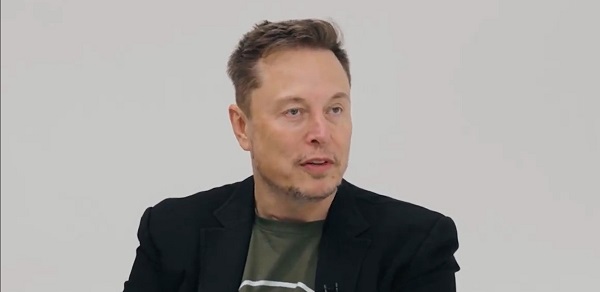
Elon Musk Warns Harris Will Try To Shut Down X ‘By Any Means Possible’ If Elected

From the Daily Caller News Foundation

Tesla CEO and X owner Elon Musk said Vice President Kamala Harris will launch “lawfare” in an effort to shut down X “by any means possible” if she wins the 2024 presidential election.
Musk sat down for a two-hour interview with former Fox News host Tucker Carlson, a co-founder of the Daily Caller and Daily Caller News Foundation, released on Monday. Musk said that should Harris win the presidency, he anticipated that he and his companies would face legal action.
“If she wins, how can they let X continue in its current form, in its current role in American society?” Carlson asked Musk about the future of the social network if Harris wins the presidency.
“They won’t,” Musk responded. “They will try to shut it down by any means possible.”
WATCH:
Former Secretary of State Hillary Clinton called for Americans to be “criminally charged” for spreading what she viewed as disinformation during a Sept. 17 interview with MSNBC host Rachel Maddow, and warned that a lack of censorship was causing a loss of “total control” in a Saturday interview with CNN host Mike Smerconish.
Carlson asked Musk to explain what he meant when he said a Harris administration would use “any means possible” to shut down X.
“They might try to pass laws,” Musk said. “They’ll try to prosecute the company, prosecute me. The amount of lawfare we’ve seen taking place is outrageous.”
Musk noted the Biden administration had sued SpaceX for failing to hire asylum seekers
“I mean… the Department of Justice, for example, launched a huge lawsuit against SpaceX for failing to hire asylum seekers,” Musk continued as Carlson expressed shock. “Not those granted asylum, but asylum seekers. Now, there’s also a law called International Traffic in Arms Regulations that because SpaceX develops advancements in technology that can be used in nuclear ICBMs… we have to be careful who we hire. We can only hire a permanent resident or a citizen.”
The Justice Department announced the suit against SpaceX in August 2023, claiming the company “discouraged asylees and refugees from applying to the company” in legal documents. The Equal Employment Opportunity Commission (EEOC) sued Tesla in September 20203. claiming black employees faced harassment and threats, including nooses.
The Biden administration launched other investigations and lawsuits into companies Musk is tied to, including Tesla, since he purchased Twitter in 2022. Musk predicted a dirty tricks campaign in May 2022, as his purchase of Twitter was in progress.
Musk has been an outspoken supporter of former President Donald Trump’s bid to return to the White House, funding America PAC, speaking at Trump’s Saturday rally at Butler, Pennsylvania, at the site of an attempted assassination of the former president and donating to efforts to elected House GOP candidates.
Harris did not immediately respond to a request for comment from the Daily Caller News Foundation.


This article supplied by Troy Media.
 By Gwyn Morgan
Canada is paying a steep economic price for climate policies that have delivered little real environmental progress
In 2015, the newly elected Trudeau government signed the Paris Agreement. The following year saw the imposition of the Pan-Canadian Framework on Clean Growth and Climate Change, which included more than 50 measures aimed at “reducing carbon emissions and fostering clean technology solutions.” Key among them was economy-wide carbon “pricing,” Liberal-speak for taxes.
Other measures followed, culminating last December in the 2030 Emissions Reduction Plan, targeting emissions of 40 per cent below 2005 levels by 2030 and net-zero emissions by 2050. It included $9.1 billion for retrofitting structures, subsidizing zero-emission vehicles, building charging stations and subsidizing solar panels and windmills. It also mandated the phaseout of coal-fired power generation and proposed stringent emission standards for vehicles and buildings.
Other “green initiatives” included the “on-farm climate action fund,” a nationwide reforestation initiative to plant two billion trees, the “Green and Inclusive Community Buildings Program” to promote net-zero standards in new construction, and a “Green Municipal Fund” to support municipal decarbonization. That’s a staggering list of nation-impoverishing subsidies, taxes and restrictions.
Those climate measures come at a real cost to the industry that drives the nation’s economy.
The Trudeau government cancelled the Northern Gateway oil pipeline to the northwest coast, which had been approved by the Harper government, costing sponsors hundreds of millions of dollars in preconstruction expenditures. The political and regulatory morass the Liberals created eventually led to the cancellation of all but one of the 12 LNG export proposals.
Have all those taxes and regulatory measures reduced Canada’s fossil-fuel consumption? No. As Bjorn Lomborg has reported, between the election of the Trudeau government in 2015 through 2023, fossil fuels’ share of Canada’s energy supply increased from 75 to 77 per cent.
That dismal result wasn’t for lack of trying. The Fraser Institute has found that Ottawa and the four biggest provinces have either spent or forgone a mind-numbing $158 billion to create just 68,000 “clean” jobs, increasing the “green economy” by a minuscule 0.3 percentage points to 3.6 per cent of GDP at an eye-watering cost of more than $2.3 million per job.
That’s Canada’s emissions reduction debacle. What’s the global picture? A decade after Paris, 80 per cent of the world’s energy still comes from fossil fuels. World energy demand is up 150 per cent. Canada, which produces roughly 1.5 per cent of global emissions, cannot influence that trajectory. And, as Lomborg writes: “achieving net zero emissions by 2050 would require the removal of the equivalent of the combined emissions of China and the United States in each of the next five years. This puts us in the realm of science fiction.”
Does this mean our planet will become unlivable? A U.S. Department of Energy report issued in July is grounds for optimism. It finds that “claims of increased frequency or intensity of hurricanes, tornadoes, floods and droughts are not supported by U.S. historical data.” And it goes on: “CO2-induced warming appears to be less damaging economically than commonly believed and aggressive mitigation policies could be more detrimental than beneficial.”
U.S. Secretary of Energy Chris Wright responded to the report by saying: “Climate change is real … but it is not the greatest threat facing humanity … (I)mproving the human condition depends on access to reliable, affordable energy.”
That leaves no doubt as to where our largest trading partner stands on carbon emissions. But don’t expect Prime Minister Mark Carney, who helped launch the Glasgow Financial Alliance for Net Zero (GFANZ) at COP 26 in that city in 2021 and co-chaired it until this January, to soften his stand on carbon taxes. His just-released budget imposes carbon tax increases of $80 to $170 per ton by 2030 on our already struggling industries.
Doing so increases Canadian businesses’ competitive disadvantage with our most important trading partner while doing essentially nothing to help the environment.
Gwyn Morgan is a retired business leader who has been a director of five global corporations.
Troy Media empowers Canadian community news outlets by providing independent, insightful analysis and commentary. Our mission is to support local media in helping Canadians stay informed and engaged by delivering reliable content that strengthens community connections and deepens understanding across the country.
From the Frontier Centre for Public Policy
By Jay Goldberg
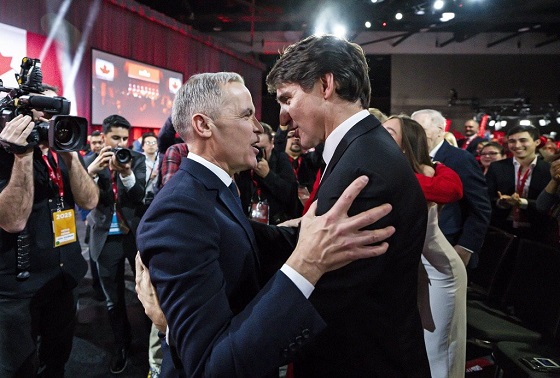
Rosy projections, chronic deficits, and opaque budgeting. If nothing changes, Carney’s credibility could collapse under the same weight.
Carney promised a fresh start. His budget makes it look like we’re still stuck with the same old Trudeau playbook
It turns out the Trudeau government really did look at Canada’s economy through rose-coloured glasses. Is the Carney government falling into the same pattern?
New research from the Frontier Centre for Public Policy shows that federal budgets during the Trudeau years “consistently overestimated [Canada’s] fiscal health” when it came to forecasting the state of the nation’s economy and finances over the long term.
In his research, policy analyst Conrad Eder finds that, when looking specifically at projections of where the economy would be four years out, Trudeau-era budgets tended to have forecast errors of four per cent of nominal GDP, or an average of $94.4 billion.
Because budgets were so much more optimistic about long-term growth, they consistently projected that government revenue would grow at a much faster pace. The Trudeau government then made spending commitments, assuming the money would be there. And when the forecasts did not keep up, deficits simply grew.
As Eder writes, “these dramatic discrepancies illustrate how the Trudeau government’s longer-term projections consistently underestimated the persistence of fiscal challenges and overestimated its ability to improve the budgetary balance.”
Eder concludes that politics came into play and influenced how the Trudeau government framed its forecasts. Rather than focusing on the long-term health of Canada’s finances, the Trudeau government was focused on politics. But presenting overly optimistic forecasts has long-term consequences.
“When official projections consistently deviate from actual outcomes, they obscure the scope of deficits, inhibit effective fiscal planning, and mislead policymakers and the public,” Eder writes.
“This disconnect between projected and actual fiscal outcomes undermines the reliability of long-term planning tools and erodes public confidence in the government’s fiscal management.”
The public’s confidence in the Trudeau government’s fiscal management was so low, in fact, that by the end of 2024 the Liberals were polling in the high teens, behind the NDP.
The key to the Liberal Party’s electoral survival became twofold: the “elbows up” rhetoric in response to the Trump administration’s tariffs, and the choice of a new leader who seemed to have significant credibility and was disconnected from the fiscal blunders of the Trudeau years.
Mark Carney was recruited to run for the Liberal leadership as the antidote to Trudeau. His résumé as governor of the Bank of Canada during the Great Recession and his subsequent years leading the Bank of England seemed to offer Canadians the opposite of the fiscal inexperience of the Trudeau years.
These two factors together helped turn around the Liberals’ fortunes and secured the party a fourth straight mandate in April’s elections.
But now Carney has presented a budget of his own, and it too spills a lot of red ink.
This year’s deficit is projected to be a stunning $78.3 billion, and the federal deficit is expected to stay over $50 billion for at least the next four years.
The fiscal picture presented by Finance Minister François-Philippe Champagne was a bleak one.
What remains to be seen is whether the chronic politicking over long-term forecasts that plagued the Trudeau government will continue to be a feature of the Carney regime.
As bad as the deficit figures look now, one has to wonder, given Eder’s research, whether the state of Canada’s finances is even worse than Champagne’s budget lets on.
As Eder says, years of rose-coloured budgeting undermined public trust and misled both policymakers and voters. The question now is whether this approach to the federal budget continues under Carney at the helm.
Budget 2025 significantly revises the economic growth projections found in the 2024 fall economic statement for both 2025 and 2026. However, the forecasts for 2027, 2028 and 2029 were left largely unchanged.
If Eder is right, and the Liberals are overly optimistic when it comes to four-year forecasts, then the 2025 budget should worry Canadians. Why? Because the Carney government did not change the Trudeau government’s 2029 economic projections by even a fraction of a per cent.
In other words, despite the gloomy fiscal numbers found in Budget 2025, the Carney government may still be wearing the same rose-coloured budgeting glasses as the Trudeau government did, at least when it comes to long-range fiscal planning.
If the Carney government wants to have more credibility than the Trudeau government over the long term, it needs to be more transparent about how long-term economic projections are made and be clear about whether the Finance Department’s approach to forecasting has changed with the government. Otherwise, Carney’s fiscal credibility, despite his résumé, may meet the same fate as Trudeau’s.
Jay Goldberg is a fellow with the Frontier Centre for Public Policy.


Canadians will soon be versed in massive West Coast LPG mega-project
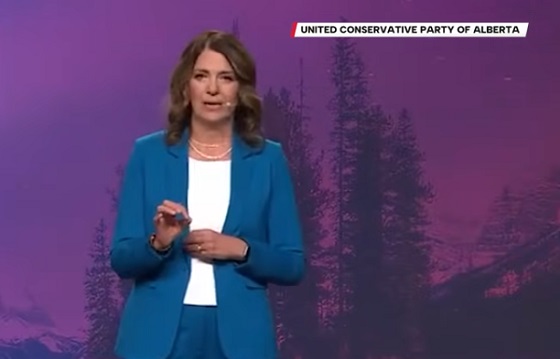
Keynote address of Premier Danielle Smith at 2025 UCP AGM

Canada Needs an Alternative to Carney’s One Man Show

Net Zero goal is a fundamental flaw in the Ottawa-Alberta MOU
-
National2 days ago
Canada Needs an Alternative to Carney’s One Man Show
-
 Alberta1 day ago
This new Canada–Alberta pipeline agreement will cost you more than you think
-
 Daily Caller2 days ago
Tech Mogul Gives $6 Billion To 25 Million Kids To Boost Trump Investment Accounts
-
 Business2 days ago
Recent price declines don’t solve Toronto’s housing affordability crisis
-
 Automotive1 day ago
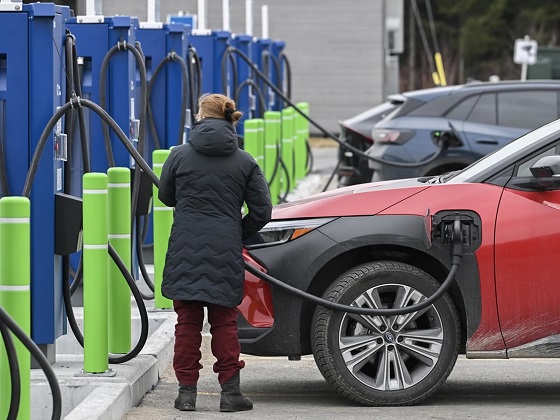
Power Struggle: Governments start quietly backing away from EV mandates
-
 Energy1 day ago
Unceded is uncertain
-
 Business2 days ago
Canada’s future prosperity runs through the northwest coast
-
Business6 hours ago
Canada’s climate agenda hit business hard but barely cut emissions