
illegal immigration
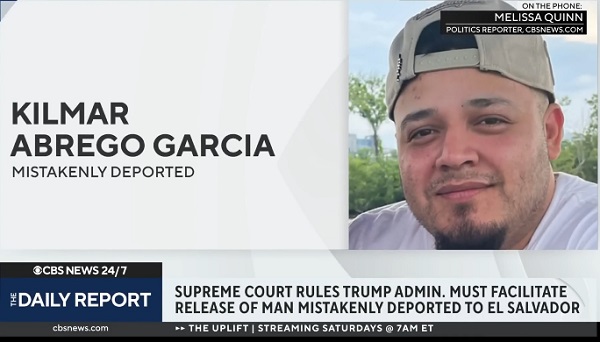
Despite court rulings, the Trump Administration shows no interest in helping Abrego Garcia return to the U.S.


 By Greg Collard
With research assistance from James Rushmore
Timeline: The Case of Kilmar Armando Abrego Garcia
With President Trump sitting next to him, El Salvador President Nayib Bukele told reporters in the Oval Office on Monday that no, he is not going to release Kilmar Armando Abrego Garcia from his country’s Terrorism Confinement Center (CECOT), despite a Justice Department lawyer admitting in a court filing that Abrego Garcia’s deportation last month was an “administrative error.”
No matter, Bukele said when asked if would return him to the U.S.:
Bukele: Of course I’m not going to do it. The question is preposterous. How can I smuggle a terrorist into the United States. I don’t have the power to return him to the United States.
Reporter: But you could release him inside El Salvador.
Bukele: Yeah, but I’m not releasing, I mean I’m not very fond of releasing terrorists into our country. We just turned the murder capital of the world into the safest country in the Western hemisphere, and you want us to go back into releasing criminals so we can go back to being the murder capital of the world? That’s not going to happen.
Not that there was any doubt what Bukele would say. Attorney General Pam Bondi set the tone early on in the meeting. She explained what the Supreme Court meant last week when it said a lower court ruling “properly requires the government to ‘facilitate’ Abrego Garcia’s release from custody in El Salvador.”
The Supreme Court ruled, president, that if El Salvador wants to return him … we would facilitate it, meaning provide a plane.
It brings to mind President Clinton’s infamous grand jury testimony when he said: “It depends upon what the meaning of the word ‘is’ is.”
Abrego-Garcia left El Salvador and illegally entered the U.S. in 2011. His status as an illegal immigrant changed after he was arrested in 2019 and the Department of Homeland Security accused him of being a member of the MS-13 gang. Abrego Garcia fought the accusation and applied for asylum. Instead, an immigration judge granted him “withholding of removal” status.
A federal judge wrote in an April 6 opinion that in El Salvador “the Barrio 18 gang had been targeting him and threatening him with death because of his family’s pupusa business.”
The Justice Department argues its hands are tied. It doesn’t matter that the U.S. is paying El Salvador $6 million a year to house U.S. deportees at CECOT.
“The United States does not have control over Abrego Garcia. Or the sovereign nation of El Salvador,” says one court filing.
Below is a timeline of the case since Abrego Garcia was arrested last month, leading up to Monday’s Oval Office meeting with Bukele.
March 12-15, 2025
ICE agents stop Abrego Garcia and tell him that he is no longer under “withholding of removal” status. The Trump administration says he is a member of the MS-13 gang, which the president has designated a foreign terrorist organization.
Abrego Garcia, who denies he is part of MS-13, is sent to an ICE detention facility in La Villa, Texas, and from there he is deported to El Salvador on March 15 along with 260 others, primarily Venezuelan nationals. He is being held in CECOT, a prison that has a capacity of 40,000 inmates.
March 24, 2025
Abrego Garcia and his wife, Jennifer Vasquez Sura, file a lawsuit that notes Abrego Garcia has been in the U.S. legally since 2019 under withholding of removal status, and that the designation was never lifted.
They also accuse the government of sending Abrego Garcia to El Salvador despite “knowing that he would be immediately incarcerated and tortured in that country’s most notorious prison; indeed, Defendants have paid the government of El Salvador millions of dollars to do exactly that. Such conduct shocks the conscience and cries out for immediate judicial relief.”
The lawsuit requests the court order the U.S. government to tell the government of El Salvador to release and deliver Abrego Garcia to the U.S. Embassy in San Salvador.
March 31, 2025
The Justice Department acknowledges in a court filing that “although ICE was aware of his protection from removal to El Salvador, Abrego Garcia was removed to El Salvador because of an administrative error.”
Still, the Justice Department argues the motion should be denied because the court “has no power” over El Salvador. Justice Department attorneys argue:
Under their (plaintiffs) logic, this Court may assume jurisdiction to decide whether the order is legal, but if the order were determined legal, then jurisdiction would disappear again.
The government also says there’s no proof that Abrego Garcia will be tortured or killed in CECOT:
Plaintiffs point to little evidence about conditions in CECOT itself (focusing primarily on its capacity for detainees), instead extrapolating from allegations about conditions in different Salvadoran prisons. While there may be allegations of abuses in other Salvadoran prisons—very few in relation to the large number of detainees—there is no clear showing that Abrego Garcia himself is likely to be tortured or killed in CECOT. More fundamentally, this Court should defer to the government’s determination that Abrego Garcia will not likely be tortured or killed in El Salvador.
April 4, 2025
U.S. District Court Judge Paula Xinis orders the Trump Administration to return Abrego Garcia to the U.S. by 11:59 p.m., April 7. She writes:
Plaintiffs are likely to succeed on the merits because Abrego Garcia was removed to El Salvador In violation of the Immigration and Nationality Act…and without any legal process; his continued presence in El Salvador, for obvious reasons, constitutes irreparable harm; the balance of equities and the public interest weigh in favor of returning him to the United States; and issuance of a preliminary injunction without further delay is necessary to restore him to the status quo and to avoid ongoing irreparable harm resulting from Abrego Garcia’s unlawful removal.
April 5, 2025
The Justice Department appeals the order, calling it “indefensible” that “a federal district judge ordered the United States to force El Salvador to send one of its citizens—a member of MS-13, no less—back to the United States by midnight on Monday. If there was ever a case for an emergency stay pending appeal, this would be it.”
More from the appellate motion:
Foremost, [the order] commands Defendants to do something they have no independent authority to do: Make El Salvador release Abrego Garcia, and send him to America. That is why Plaintiffs did not even ask the district court for an order directing Abrego Garcia’s return. As Plaintiffs themselves acknowledged, a federal court “has no jurisdiction over the Government of El Salvador and cannot force that sovereign nation to release Plaintiff Abrego Garcia from its prison.” That concession is all that is needed to order a stay here. No federal court has the power to command the Executive to engage in a certain act of foreign relations; that is the exclusive prerogative of Article II, immune from superintendence by Article III.
April 6, 2025
Judge Xinis issues a follow-up memorandum opinion to her April 4 order:
Although the legal basis for the mass removal of hundreds of individuals to El Salvador remains disturbingly unclear, Abrego Garcia’s case is categorically different—there were no legal grounds whatsoever for his arrest, detention, or removal. Nor does any evidence suggest that Abrego Garcia is being held in CECOT at the behest of Salvadoran authorities to answer for crimes in that country. Rather, his detention appears wholly lawless.
The judge also writes that in 2019, Homeland Security “relied principally on a singular unsubstantiated allegation that Abrego Garcia was a member of MS-13.”
April 7, 2025
A three-judge panel of Fourth U.S. Circuit Court of Appeals unanimously denies the government’s motion for a stay of Xinis’ order that say Abrego Garcia must be returned to the U.S. by 11:59 p.m. Judge Stephanie Thacker writes:
The United States Government has no legal authority to snatch a person who is lawfully present in the United States off the street and remove him from the country without due process. The Government’s contention otherwise, and its argument that the federal courts are powerless to intervene, are unconscionable.
The Trump Administration appeals to the U.S. Supreme Court, and Chief Justice John Roberts grants an administrative stay to give justices time to consider the case.
Following the stay, Bondi accuses Abrego Garcia of being a “violent gang member”:
We will continue to fight for the safety of Americans and get these people out of our country to make America safe.
April 10, 2025
The Supreme Court rules against the Trump administration but directs Judge Xinis to “clarify” a portion of her ruling. From the Supreme Court’s decision:
The order properly requires the Government to “facilitate” Abrego Garcia’s release from custody in El Salvador and to ensure that his case is handled as it would have been had he not been improperly sent to El Salvador. The intended scope of the term “effectuate” in the District Court’s order is, however, unclear, and may exceed the District Court’s authority. The District Court should clarify its directive, with due regard for the deference owed to the Executive Branch in the conduct of foreign affairs. For its part, the Government should be prepared to share what it can concerning the steps it has taken and the prospect of further steps.
April 11, 2025
If the Supreme Court said, ‘Bring somebody back,’ I would do that. I respect the Supreme Court.
President Trump says that aboard Air Force One a day after the Supreme Court upholds a lower court ruling and says the government should “facilitate” Abrego Garcia’s return to the U.S.
Meanwhile, Judge Xinis issues a new order that directs the government to “take all available steps to facilitate the return” of Abrego Garcia. In a hearing, she also makes clear her frustration with the Justice Department.
“The record, as it stands, is, despite this court’s clear directive, your clients have done nothing to facilitate the return of Mr. Abrego Garcia,” she says.
Xinis also orders the administration to provide daily updates on the status of Abrego Garcia’s return. She also criticizes Justice Department attorneys in her order:
During the hearing, the Court posed straightforward questions, including: Where is Abrego Garcia right now? What steps had Defendants taken to facilitate his return while the Court’s initial order on injunctive relief was in effect…? Defendants’ counsel responded that he could not answer these questions, and at times suggested that Defendants had withheld such information from him. As a result, counsel could not confirm, and thus did not advance any evidence, that Defendants had done anything to facilitate Abrego Garcia’s return. This remained Defendants’ position even after this Court reminded them that the Supreme Court of the United States expressly affirmed this Court’s authority to require the Government “facilitate” Abrego Garcia’s return. From this Court’s perspective, Defendants’ contention that they could not answer these basic questions absent some nonspecific “vetting” that has yet to take place, provides no basis for their lack of compliance.
April 12, 2025
A State Department official reports to the court that Abrego Garcia is “alive and secure” at CECOT. “He is detained pursuant to the sovereign, domestic authority of El Salvador,” the State Department’s Michael Kozak says in a filing.
However, he does not give an update on the status of Abrego Garcia’s return to the U.S.

illegal immigration
While Trump has southern border secure, hundreds of thousands of illegal immigrants still flooding in from Canada

From The Center Square
By
Under the Biden administration, the greatest number of illegal border crossers at the U.S.-Canada border were reported in U.S. history, breaking records nearly every month for four years, The Center Square first reported.
While record high numbers dropped under the Trump administration, illegal entries still remain high in northern border states, with some states reporting more apprehensions in 2025 than during the Biden years.
Fourteen U.S. states share the longest international border in the world with Canada, totaling 5,525 miles across land and water.
The majority of illegal border crossers were apprehended and encountered in five northern border states, according to U.S. Customs and Border Protection data analyzed by The Center Square. Nearly half were reported in New York. Washington, Vermont, Maine and Montana recorded the next greatest numbers.
The majority of northern border states reported the greatest number of illegal entries in U.S. history in 2024, the last year of the Biden administration, according to CBP data. At the height of the border crisis, illegal entries reached nearly 200,000 at the northern border in 2024 and in 2023, first reported by The Center Square.
For fiscal years 2022 through 2025, 754,928 illegal border crossers were reported in 14 northern border states, according to the latest available CBP data.
From west to east, illegal entries at the northern border totaled:
-
Alaska: 7,380
-
Washington: 135,116
-
Idaho: 620
-
Montana: 32,036
-
North Dakota: 14,818
-
Minnesota: 8,315
-
Wisconsin: 118
-
Michigan: 50,321
-
Ohio: 1,546
-
Pennsylvania: 19,145
-
New York: 363,910
-
Vermont: 61,790
-
New Hampshire: 82
-
Maine: 59,731
Notably, Alaska, Idaho, New York, Pennsylvania and Wisconsin reported record high illegal crossings in 2023. Although Montana and North Dakota saw a drop in 2025 from record highs in 2024, the number of illegal border crossers apprehended in the two states in 2025 were greater than they were in 2022; in Montana they were more than double.
The data only includes nine months of the Trump administration. The CBP fiscal year goes from Oct. 1 through Sept. 30. Biden administration data includes the first three months of fiscal 2025, nine months of fiscal 2021, and all of fiscal years 2022, 2023 and 2024. Combined, illegal northern border crosser apprehensions totaled roughly one million under the Biden administration, according to CBP data.
The data excludes “gotaways,” the official term used by CBP to describe foreign nationals who illegally enter between ports of entry to evade capture, don’t make immigration claims and don’t return to their country of origin. CBP does not publicly report gotaway data. The Center Square exclusively obtained it from Border Patrol agents. More than two million gotaways were identified by Border Patrol agents under the Biden administration, although the figure is expected to be much higher, The Center Square first reported.
For decades, the northern border has been largely unmanned and unprotected with increased threats of terrorism and lack of operational control, The Center Square reported.
Unlike the 1,954-mile U.S.-Mexico border, there is no border wall, significantly less technological equipment exists and far fewer agents are stationed there.
Officials have explained that the data represents a fraction of illegal border crossers – it remains unclear how many really came through largely remote areas where one Border Patrol agent may be responsible for patrolling several hundred miles, The Center Square has reported.
Despite being understaffed and having far less resources, Border Patrol and CBP agents at the U.S.-Canada border apprehended the greatest number of known or suspected terrorists (KSTs) in U.S. history during the Biden administration – 1,216, or 64% of the KSTs apprehended nationwide, The Center Square exclusively reported.
In February, President Donald Trump for the first time in U.S. history declared a national emergency at the northern border, also ordering the U.S. military to implement border security measures there. After shutting down illegal entries at the southwest border, the administration acknowledged the majority of fentanyl and KSTs were coming through the northern border, The Center Square reported.
The Trump administration has also prioritized increased funding, recruitment and hiring and investment in technological capabilities at the northern border.
Daily Caller
Tom Homan Predicts Deportation Of Most Third World Migrants Over Risks From Screening Docs


From the Daily Caller News Foundation
White House border czar Tom Homan predicted Sunday the Trump administration will deport the majority of Third World migrants due to vetting challenges.
Two National Guardsmen were shot Wednesday, allegedly by an Afghan national brought into the U.S. under the Biden administration. The attack prompted President Donald Trump to announce in a Thursday post on Truth Social that his administration would “permanently pause migration from all Third World Countries.” Homan said on Fox News’s “Sunday Morning Futures” that Third World nations could not be relied upon to provide accurate information for vetting migrants.
Dear Readers:
As a nonprofit, we are dependent on the generosity of our readers.
Please consider making a small donation of any amount here.
Thank you!
“[T]hese Third World nations, they don’t have systems like we do. So, a lot of these Afghanistans, when they did get here and get vetted, they had no identification at all. Not a single travel document, not one piece of identification,” Homan said. “And we’re going to count on the people that run Afghanistan, the Taliban, to provide us any information [on] who the bad guys were or who the good guys are? Certainly not. And many people need to understand that most terrorists in this world, most of ’em, aren’t in any database.”
“And the same thing with illegal aliens, the over 10 million that came across the border under Joe Biden. There’s no way to vet these people. You think El Salvador or Turkey or Sudan or any of these countries have the databases or system checks that we have?” he added. “Do you think the government[s] of China, Russia, Turkey, do you think they’re going to share that data with us even if they did have it? There’s no way to clearly vet these people 100% that they’re safe to come to this country from these Third World nations.”
The president also wrote in his Thursday post he would “terminate all of the millions of Biden illegal admissions,” along with deporting those who do not offer value to the United States. Homan said Trump is correct to evaluate all migrants who entered under Biden.
“I really, truly think that most of ’em are [going to] end up being deported ’cause we’re not going to be able to properly vet them,” he said.
Similarly, Homeland Security Secretary Kristi Noem asserted Sunday on NBC News’s “Meet the Press” the Trump administration would deport individuals with pending asylum claims.
West Virginia Army National Guard Specialist Sarah Beckstrom, 20, perished Thursday from wounds sustained in Wednesday’s shooting. The other victim, Air Force Staff Sgt. Andrew Wolfe, remains in critical condition at the time of publication.
The shooting was allegedly carried out by Rahmanullah Lakanwal, who entered the country in September 2021 after the U.S. military’s withdrawal from Afghanistan. Lakanwal previously worked with the U.S. government, including the CIA, and was admitted into the U.S. under the Biden administration’s Operation Allies Welcome, which resettled Afghans who had helped American forces.
Lakanwal applied for asylum in 2024, which the Trump administration granted in April 2025, according to Reuters. The alleged gunman shouted, “Allahu akbar!” before opening fire with a revolver, independent journalist Julio Rojas reported.
As of December 2024, over 180,000 Afghans were resettled in the U.S. following its August 2021 withdrawal, according to the State Department. After the shooting, the U.S. Citizenship and Immigration Services (USCIS) announced that the “processing of all immigration requests relating to Afghan nationals” would be paused “indefinitely.”
USCIS also asserted Thursday it would conduct a full-scale reexamination of all green cards granted to individuals from 19 countries “of concern” at Trump’s direction. The agency added in a later statement that, when vetting migrants from those nations, it would weigh “negative, country specific factors,” such as whether the country was able to “issue secure identity documents.”


Trump Deals Biden’s EV Dreams A Death Blow
Liberal bill “targets Christians” by removing religious exemption in hate-speech law

Pharma Bombshell: President Trump Orders Complete Childhood Vaccine Schedule Review

Senate votes to reopen Alaska Coastal Plain to energy leasing
-
National1 day ago
Liberal bill “targets Christians” by removing religious exemption in hate-speech law
-
 Crime1 day ago
Inside the Fortified Sinaloa-Linked Compound Canada Still Can’t Seize After 12 Years of Legal War
-
 Business1 day ago
Looks like the Liberals don’t support their own Pipeline MOU
-
 Business2 days ago
The Climate-Risk Industrial Complex and the Manufactured Insurance Crisis
-
 Health2 days ago
The Data That Doesn’t Exist
-
 Business20 hours ago
Conservative MP warns Liberals’ national AI plan could increase gov’t surveillance
-
 Business1 day ago
Canada Can Finally Profit From LNG If Ottawa Stops Dragging Its Feet
-
 C2C Journal7 hours ago
Wisdom of Our Elders: The Contempt for Memory in Canadian Indigenous Policy