
Indigenous
Canada’s Indigenous Model is Not Sustainable


From the Frontier Centre for Public Policy
The stated purpose of the extra indigenous spending that has always been there, and the virtual explosion on indigenous spending since 2015 is meant to fix that problem. But these massive expenditures have now reached the point where they risk destabilizing the country.
Canada’s parliamentary budget officer, Yves Giroux has spoken out about the alarming rise in Canada’s contingent liabilities related to indigenous claims. Todays estimated 76 billion dollars is many times the 15 billion dollars it was when the Liberals took power in 2015.
This is one part only of the massive increase in spending on indigenous matters that has taken place since then.
Federal spending per indigenous person has always been much higher than spending per non-indigenous person. The higher level of spending has been justified because most indigenous people do much worse on virtually every health and social indicator than the mainstream population. Their health is poorer, and their lives are shorter.
This disparity was generally known as Canada’s “Indian problem”. That term is no longer fashionable, and the extra spending is now said to be necessary to achieve “reconciliation”. Regardless of the terms, what is clear is that since Confederation there has always existed a large rural and urban indigenous underclass that does poorly compared to the mainstream. The stated purpose of the extra indigenous spending that has always been there, and the virtual explosion on indigenous spending since 2015 is meant to fix that problem. But these massive expenditures have now reached the point where they risk destabilizing the country.
Perhaps it’s time for Canadians to ask if the “nation to nation” reconciliation plan that spending is based on is working. Is it fixing the problem?
A recent CBC report proves that it is not. Instead, the problems are getting worse.
The CBC investigated an indigenous community at St. Theresa Point where 24 people sometime share one house. Almost all of the houses in the community are crumbling and need to be replaced. Families struggle to achieve basic hygiene. Living conditions resemble what one would expect to find in a third world community, and not in wealthy, modern Canada.
St. Theresa Point is typical of hundreds of other Indian remote reserves. Most are almost totally dependent on the federal government for their survival. There is virtually no real employment. The poorest people in those communities are directly dependent on welfare checks, but even the chief, councillors and other employees receive their paycheques from the transfer payments sent by Ottawa. In reality almost everyone in the community is on welfare of some type.
Unlike in other rural communities, people on poor reserves tend not to move when economic opportunities decline. In small-town Canada, the rules are simple: If the towns or farms can’t supply enough jobs, one moves to the city where the jobs and careers are. But on remote reserves, most people stay put, even if there are no jobs or careers there for them. And most of those who do move to the city do not do well. A lack of education, poor job skills, and lack of motivation usually consign reserve residents who move to the mean parts of town where many end up in gangs, crime and prostitution. The result is that the people who stay in uneconomic remote reserves become more and more dependent. Low education levels sink even further. And succeeding generations become ever less likely to be able to provide for themselves and their families.
To make matters much worse, addiction problems are endemic. At one time, alcohol was the drug of choice. Now, amphetamines, fentanyl, and prescription drugs have been added to the list, with the family violence, sexual abuse, crime, teenage pregnancy and fetal alcohol births that inevitably follow from chronic drug use.
And reserve populations are growing. Although status Indians living on reserves currently comprise only about 1% of the total population, they are the country’s fastest growing demographic. The cost of operating these communities is crippling now, but in a few years, it will be completely unsustainable. Pretending that these desperately poor reserves are sovereign “nations” that will somehow magically become prosperous and self-supporting is a cruel joke on the young people hopelessly trapped on them. The prospect of hundreds of dependent reserves teeming with, unemployed, and largely unemployable young people, with massive social problems, is a frightening dystopia – hundreds of Gaza strips. But it is where we are headed. To make things even worse, the government-promoted false genocide and “missing children” narratives have made many of these people very angry.
Although there is no treaty right, or any other right to free housing on a reserve the reality is that if the government did not provide housing for the reserve residents, they would be unable to provide housing for themselves. The strange result is that Canadian taxpayers – many of whom will never be able to afford to buy a house themselves – pay through their tax dollars for houses for the rapidly growing reserve population. These houses deteriorate quickly, because they are considered “free” by the residents, and have to be fixed and replaced in a wasteful and expensive cycle.
And it is a national disgrace that most reserves are dead ends for most of the young people born into them.
The late Farley Mowat described northern indigenous settlements as “unguarded concentration camps”. That might be a somewhat harsh way to describe reserves, but at best most are human warehouses, plagued with social problems. The young people living there deserve some hope, and Canada’s current plan for them offers them none.
So, Canada’s current indigenous plan is clearly not working. Is there a better plan for success?
Maybe we should ask Wab Kinew, Manitoba’s new premier. He is indigenous and highly successful. How did he get there?
The formula is actually not complicated. It has nothing to do with massive welfare giveaways, “nation to nation” utopias, or incredibly expensive “reconciliation” projects. It definitely has nothing to do with staying in a community that lacks economic opportunities, and waiting for handouts. It involves education, hard work, and going where the jobs are. Kinew’s parents realized that a stable home and education were key. Wab did the rest. He worked his way up the ladder in the usual way, and went where the jobs were. He did that with his indigenous identity intact.
Not every young person has Kinew’s talent, but everyone can follow the formula that made Kinew, and many other indigenous achievers successful.
The alternative – spending ever increasing amounts on a steadily increasing list of demands from a growing dependent reserve population is not an option. We don’t need the parliamentary budget officer to tell us that it is not sustainable.
As for remote, uneconomic reserves, like St. Theresa Point, they should be gradually and humanely closed down. It has been recognized for many years that reserves long ago had served their purpose, and should be phased out. As far back as 1911, it was said:
“Department officials were increasingly coming to the view that reserves had outlived their usefulness. Frank Pedley suggested that they resulted in the isolation and segregation of Indians, and thereby hindered progress…and encouraged the tribal form of government.”
The reserve system was not ended in 1911 because the chiefs and ruling families refused to give up their privileged positions. It isn’t happening today for the same reasons. We still have the same Indian Act and reserve system that has held indigenous people back for almost 150 years. (Senior Ontario lawyer, Peter Best, describes the toxicity of the reserve system in his important book, There Is No Difference)
So, the long-term plan should be to find a way to overcome that resistance, and find a fair way to phase out reserves, and the antiquated Indian Act. The reserves that are economically viable can merge into existing rural municipalities, or become stand-alone municipalities. Opportunities should be made available for young people from uneconomic communities to move to job centres, and receive help to succeed there.
In the meantime, the example of Wab Kinew is proof that there has never been a better time or place than today’s Canada to be an educated and ambitious young indigenous person who is willing to study, work hard, and go where the jobs are.
Brian Giesbrecht is a retired judge and senior fellow at Frontier Centre for Public Policy
Watch Brian on Return to Reason here.

Indigenous
Residential school burials controversy continues to fuel wave of church arsons, new data suggests

By Edgardo Sepulveda for Inside Policy
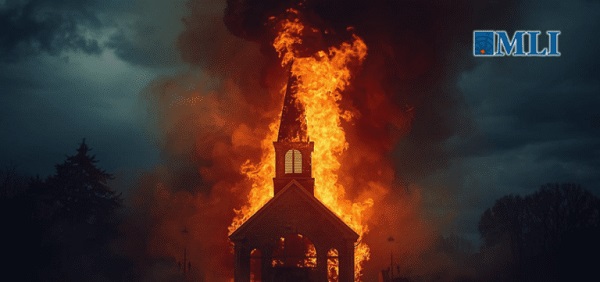
Church arsons surged again in 2024 according to new data released by Statistics Canada—continuing a disturbing trend first uncovered by a Macdonald-Laurier Institute investigation published last year.
Scorched Earth: A quantitative analysis of arson at Canadian religious institutions and its threat to reconciliation, which I published last April, warned that the arson wave – almost certainly spurred by ongoing anger over potential unmarked burials of children at residential schools –would not disappear without concerted government policy intervention.
Unfortunately, my prediction is proving accurate.
Newly available custom data from Statistics Canada confirms that arsons in 2024 continued at nearly double the baseline level established from 2011–17.
This persistent elevation is particularly concerning given that arson is a dangerous crime with significant financial costs and, in the case of religious institutions, broader implications for Canadian society and political discourse. Most importantly for those committed to Indigenous reconciliation, the apparent lack of effective policy response risks undermining public support for reconciliation efforts—suggesting these crimes are not being treated with the seriousness they deserve, particularly because many targets are Catholic churches associated with residential school legacies.
Scorched Earth developed specific terms and a conceptual framework to analyze arsons at religious institutions. First, I refer to “potential unmarked burials” rather than other terminology, including “mass graves” – language suggesting verified remains and, potentially, the site of clandestine burials. Neither has been established. No remains have been verified at any of the 21 announced sites. The Tk’emlúps te Secwépemc First Nation revised its own characterization of the Kamloops, BC, announcements in May 2024 to “probable unmarked burial sites,” a significant shift from its initial May 2021 announcement of “remains of 215 children.” This precipitated announcement, together with some of the initial media coverage in Canada and elsewhere, likely contributed to the intensity of the arson response.
Second, the conceptual framework, updated with the latest Statistics Canada data, separates “baseline” from “excess” arson associated with specific shocks, such as the announcements. It shows that arsons at religious institutions have remained elevated since the initial spike in 2021. Based on careful geographic statistical analysis presented in Scorched Earth, I demonstrated that the most likely explanation for elevated arsons was a criminal response prompted by the 17 announcements of potential unmarked burials at former residential schools, beginning in Kamloops, B.C., in May 2021. Four additional announcements occurred in 2024, bringing the total to 21. While data through 2023 showed no detectable increase in arsons related to the Israel-Gaza conflict, analysis of 2024 data suggests this changed: arsons in response to that conflict now constitute a minority of the increase above baseline levels, with the majority remaining those related to announcements of potential unmarked burials.
Investigation and Prosecution Rates Remain Insufficient for Effective Deterrence
Statistics Canada’s newly released custom clearance data for arson at religious institutions provides the first comprehensive official view of law enforcement effectiveness in these cases, superseding the preliminary compilation included in Scorched Earth.
Crimes in Canada are considered “solved” when police identify a suspect with sufficient evidence to support charges. Cases are then classified as “cleared” through two mechanisms: laying charges (“cleared by charge”) or alternative processes such as diversion programs (“cleared otherwise”).
As Figure 2 illustrates, the cleared-by-charge rate for all arson averaged 13.1 per cent over the 2011–24 period. For religious institutions, the yearly average reached 14.4 per cent—marginally higher but still concerning. The clearance rate for religious institutions shows significant year-over-year variability, reflecting the smaller statistical base compared to all arsons. The “cleared otherwise” category adds an average of 4.7 per cent for both arson types.
While these low clearance rates align with those for other property crimes, the continuing elevated arson rate suggests they provide insufficient deterrence for either first-time or serial arsonists. Evidence from Scorched Earth indicates that sustained clearance rates in the mid-30 per cent range—achieved by the National Church Arson Task Force (NCATF) in the United States during the 1990s—effectively reduced church arsons targeting predominantly Black congregations in the American South.
While my statistical analysis indicates that announcements of potential unmarked burials likely motivated many incidents, this remains circumstantial evidence. Direct evidence would require confessions or explicit statements of rationale from arrested arsonists, or credible claims of responsibility from organized groups. Out of the 306 arsons at religious institutions over the 2021-24 period, 53 resulted in charges and 13 were cleared through alternative processes, totaling 64 cleared incidents—an overall clearance rate of 21 per cent.
A clearance rate at this level, while insufficient for effective deterrence, makes it unlikely that most arsons during this period resulted from organized political, ideological, or anti-religious campaigns. A coordinated campaign would likely be visible to investigators even at this clearance level. Since police identify suspects in far more cases than they prosecute, investigators develop a broader perspective on potential culprits than clearance rates alone suggest. Law enforcement officials have not provided any indication of such organized campaigns.
Federal and Provincial Funding Addresses Searches But Ignores Consequences
Neither federal nor provincial governments have introduced policy initiatives addressing elevated arson rates at religious institutions, despite substantial new funding for related matters.
Following the Kamloops announcement, the federal government launched the Residential Schools Missing Children Community Support program, providing $246 million to hundreds of communities, including for research and field investigations. Separately, British Columbia, Alberta, Ontario, and other provinces have committed hundreds of millions in additional dollars, including programs to address mental health effects from the search process and announcements.
This funding inventory highlights a significant policy gap: substantial resources address the cause—announcements of potential unmarked burials—while none target the effect: arsons at religious institutions.
Even viewed narrowly as a crime issue, recent government responses to other property crimes demonstrate available policy tools. When auto theft peaked in 2023, the federal government announced $121 million in federal support, convened a national summit with all levels of government and law enforcement, and released a National Action Plan by May 2024.
Policy Gaps and a Call to Action
The NCATF, created in response to arsons targeting Black churches in the 1990s United States, achieved clearance rates sufficient to reduce incidents. Canada possesses the same policy tools but has not deployed them for residential school-related arsons.
This is not a matter of capacity or institutional precedent. Recent government responses to other serious property crimes, such as auto theft, demonstrate that Canada can mobilize coordinated federal-provincial action when it chooses to. The apparent policy inaction since 2021 for residential school-related arsons must end.
Canada is not powerless to stop the arsonists. The policy recommendations set out in Scorched Earth continue to be valid:
- Create a national or regional integrated police/fire investigations unit focused specifically on arson at religious institutions. This integrated unit would investigate arsons at all religious institutions—Christian, Muslim, Jewish, and others.
- Improve Indigenous police and fire protection services, including to ensure full Indigenous participation in the integrated unit.
- Complete the long-running project of building and maintaining a comprehensive and timely national and on-reserve database of fire statistics.
Law enforcement officials must thoroughly investigate and prosecute the arsonists. The attacks threaten reconciliation and full Indigenous equality—and they must be condemned by all Canadians.
Economist Edgardo Sepulveda has more than 30 years of experience advising clients in more than forty countries. He has written for Jacobin magazine, TVO Today, and the Alberta Federation of Labour, and has been lead author of three peer-reviewed academic articles in the last five years. He received his BA (Hon) from the University of British Columbia and his MA from Queen’s University, both in Economics. He established Sepulveda Consulting Inc. in 2006.
illegal immigration
EXCLUSIVE: Canadian groups, First Nation police support stronger border security
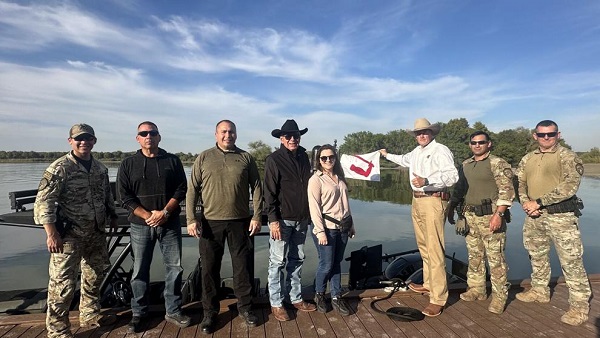
First Nation police chiefs join Texas Department of Public Safety marine units to patrol the Rio Grande River in Hidalgo County, Texas. L-R: Dwayne Zacharie, President of the First Nations Chiefs of Police Association, Ranatiiostha Swamp, Chief of Police of the Akwesasne Mohawk Territory, Brooks County Sheriff Benny Martinez, Jamie Tronnes, Center for North American Prosperity and Security, Goliad County Sheriff Roy Boyd. Photo: Bethany Blankley for The Center Square
From The Center Square
By
Despite Canadian officials arguing that the “Canada-U.S. border is the best-managed and most secure border in the world,” some Canadian groups and First Nation tribal police chiefs disagree.
This week, First Nation representatives traveled to Texas for the first time in U.S.-Canadian history to find ways to implement stronger border security measures at the U.S.-Canada border, including joining an Operation Lone Start Task Force, The Center Square exclusively reported.
Part of the problem is getting law enforcement, elected officials and the general public to understand the reality that Mexican cartels and transnational criminal organizations are operating in Canada; another stems from Trudeau administration visa policies, they argue.
When it comes to public perception, “If you tell Canadians we have a cartel problem, they’ll laugh at you. They don’t believe it. If you tell them we have a gang problem, they will absolutely agree with you 100%. They don’t think that gangs and cartels are the same thing. They don’t see the Hells Angels as equal to the Sinaloa Cartel because” the biker gang is visible, wearing vests out on the streets and cartel operatives aren’t, Jamie Tronnes, executive director of the Center of North American Prosperity and Security, told The Center Square in an exclusive interview.
The center is a US-based project of the MacDonald-Laurier Institute, the largest think tank in Canada. Tronnes previously served as a special assistant to the cabinet minister responsible for immigration and has a background in counterterrorism. She joined First Nation police chiefs to meet with Texas law enforcement and officials this week.
Another Canadian group, Future Borders Coalition, argues, “Canada has become a critical hub for transnational organized crime, with networks operating through its ports, banks, and border communities.” The Sinaloa and Jalisco New Generation Mexican cartels control the fentanyl, methamphetamine and cocaine business in Canada, partnering with local gangs like the Hells Angels and Chinese Communist Party (CCP)-linked actors, who launder profits through casinos, real estate, and shell companies in Vancouver and Toronto, Ammon Blair, a senior fellow at the Texas Public Policy Foundation, and others said at a coalition event prior to First Nation police chiefs and Tronnes coming to Texas.
“The ’Ndrangheta (Italian Mafia) maintains powerful laundering and import operations in Ontario and Quebec, while MS-13 and similar Central American gangs facilitate human smuggling and enforcement. Financial networks tied to Hezbollah and other Middle Eastern groups support laundering and logistics for these criminal alliances,” the coalition reports.
“Together, they form interconnected, technology-driven enterprises that exploit global shipping, cryptocurrency, and AI-enabled communications to traffic whatever yields profit – narcotics, weapons, tobacco, or people. Taking advantage of Canada’s lenient disclosure laws, fragmented jurisdictions, and weak cross-border coordination, these groups have embedded themselves within legitimate sectors, turning Canada into both a transit corridor and safe haven for organized crime,” the coalition reports.
Some First Nation reservations impacted by transnational crime straddle the U.S.-Canada border. One is the Akwesasne Mohawk Reservation, located in Ontario, Quebec, and in two upstate New York counties, where human smuggling and transnational crime is occurring, The Center Square reported. Another is the Tsawwassen First Nation (TWA) Reservation, located in a coastal region south of Vancouver in British Columbia stretching to Point Roberts in Washington state, which operates a ferry along a major smuggling corridor.
Some First Nation reservations like the TWA are suffering from CCP organized crime, Tronnes said. Coastal residents observe smugglers crossing their back yards, going through the reserve; along Canada’s western border, “a lot of fentanyl is being sent out to Asia but it’s also being made in Canada,” Tronnes said.
Transnational criminal activity went largely unchecked under the Trudeau government, during which “border security, national security and national defense were not primary concerns,” Tronnes told The Center Square. “It’s not to say they weren’t concerns, but they weren’t top of mind concerns. The Trudeau government preferred to focus on things like climate change, international human rights issues, a feminist foreign policy type of situation where they were looking more at virtue signaling rather than securing the country.”
Under the Trudeau administration, the greatest number of illegal border crossers, including Canadians, and the greatest number of known, suspected terrorists (KSTs) were reported at the U.S.-Canada border in U.S. history, The Center Square first reported. They include an Iranian with terrorist ties living in Canada and a Canadian woman who tried to poison President Donald Trump, The Center Square reported.
“Had it been a priority for the government to really crack down and provide resources for national security,” federal, provincial and First Nation law enforcement would be better equipped, funded and staffed, Tronnes said. “They would have better ways to understand what’s really happening at the border.”
In February, President Donald Trump for the first time in U.S. history declared a national emergency at the northern border and ordered U.S. military intervention. Months later, his administration acknowledged the majority of fentanyl and KSTs were coming from Canada, The Center Square reported.
Under a new government and in response to pressure from Trump, Canada proposed a $1.3 billion border plan. However, more is needed, the groups argue, including modernizing border technology and an analytics infrastructure, reforming disclosure and privacy rules to enable intelligence sharing, and recognizing and fully funding First Nation police, designating them as essential services and essential to border security.
“National security doesn’t exist without First Nation policing at the border,” Dwayne Zacharie, First Nations Chiefs of Police president, told The Center Square.


Death by a thousand clicks – government censorship of Canada’s internet

‘Almost Sounds Made Up’: Jeffrey Epstein Was Bill Clinton Plus-One At Moroccan King’s Wedding, Per Report

Danielle Smith slams Skate Canada for stopping events in Alberta over ban on men in women’s sports
Saskatchewan woman approved for euthanasia urged to seek medical help in Canada rather than US
-
Daily Caller2 days ago
‘Almost Sounds Made Up’: Jeffrey Epstein Was Bill Clinton Plus-One At Moroccan King’s Wedding, Per Report
-
 Business14 hours ago
Argentina’s Milei delivers results free-market critics said wouldn’t work
-
 Alberta2 days ago
Housing in Calgary and Edmonton remains expensive but more affordable than other cities
-
 Business1 day ago
State of the Canadian Economy: Number of publicly listed companies in Canada down 32.7% since 2010
-
 International1 day ago
DOJ fails to fully comply with Friday deadline for Epstein files release
-
 Bruce Dowbiggin1 day ago
Hunting Poilievre Covers For Upcoming Demographic Collapse After Boomers
-
 Business2 days ago
Trump signs order reclassifying marijuana as Schedule III drug
-
 Crime2 days ago
Brown University shooter dead of apparent self-inflicted gunshot wound