
Frontier Centre for Public Policy
Canada Fulfills the Dystopian Vision


From the Frontier Centre for Public Policy
By Lee Harding
The country our ancestors built is being torn down. The welfare state runs on massive deficits, increasing our public fiscal slavery. Cancel culture kills free speech. The government funds the Anti-Hate Network to oppose religious conservatives, which negatively stereotypes them.
Poet T.S. Elliot once wrote, “This is the way the world ends. Not with a bang but a whimper.” Canada has fallen but has all the illusion of being what it always was. Many Canadians fail to see a dystopian future foretold decades ago has arrived. Our institutions are failing us.
In Orwellian fashion, The Charter of Rights and Freedoms has transformed Canadian values in the pretense of upholding them. They eliminated federal laws that made Sunday a day of rest, forced the provision of abortion and euthanasia in the name of the security of the person, and banned prayer from city hall meetings in the name of religious freedom.
The pandemic cranked the judges’ distorted amp right up to 11. In B.C., Chief Justice Christopher Hinkson struck down public health orders banning protests, but quizzically maintained the ban on religious assembly. Elsewhere, the hypocrisy just continued, laws or no laws.
Ontario Premier Doug Ford and Prime Minister Justin Trudeau could bow the knee at Black Lives Matter protests that exceeded gathering limits, while those who did so for church services or rallies against mandates were prosecuted–or even persecuted. The Walmarts and Superstores were packed, while the churches and small businesses sat empty.
Doctors who prescribed ivermectin, one of the safest and widely effective drugs of all time, faced medical censure–even if their actions saved lives. Medical colleges became bodies that betray the profession’s values by banning medical opinions and the off-label use of drugs when it contradicts poor policies based on weak evidence.
The media, which should have been pushing back at this nonsense, went along with the charade as if it was the right thing to do. Any perspective that could foment doubt against the recommendations and policies of those in power was banned. Such is the practice of authoritarian countries, which is what Canada became.
As law professor Bruce Pardy has noted, Canada has shifted from the rule of law to the rule by laws. Here, legal systems manage the public and the law and courts fail to call the governments to account. A rally that’s permitted one minute can be trampled by the Emergencies Act the next, while donors to a protest see their bank accounts seized. Did you lose your job for refusing a vaccine? Too bad. Oh, and you don’t get EI either.
The pandemic and its fear subsided, but neither sober reflection nor an adequate reckoning arrived. People kept getting COVID after the vaccinations, yet some are getting booster shots to this day. Analysts such as Denis Rancourt, credit public responses, including vaccines, for worldwide excess mortality of 17 million. Yet, the bombshell falls like a dud, either ignored or diffused by dismissive “fact-checkers.” The life expectancy of Canadians dropped two full years and barely a shoulder was shrugged.
Even our elections fail to inspire confidence. In many municipalities, programmable computers count the votes and no one checks or scrutinizes the paper ballots. In other cases, paper ballots don’t exist–it’s all done on screen. A computer gets the trust a single individual would never receive.
The country our ancestors built is being torn down. The welfare state runs on massive deficits, increasing our public fiscal slavery. Cancel culture kills free speech. The government funds the Anti-Hate Network to oppose religious conservatives, which negatively stereotypes them.
Gender ideology, now entrenched in law and schools, is facilitating a wedge between traditional values and woke values and between parents and their children. It even challenges the objective truth of biological reality. Truth has become what we feel, overriding rational norms, facts, and our inherited society.
Like George Orwell’s 1984, if the government says 2 + 2 = 5, then that’s what it is, and anyone who fails to accept it becomes an enemy of the state. Orwell’s novel envisioned a time when false propaganda like “war is peace” and “freedom is slavery” would prevail. The dystopia has arrived. Anyone who refers to someone by their biological sex is accused of misgendering hate.
Unfortunately,the dark vision of Aldous Huxley is also unfolding. In 1958, the author of Brave New World Revisited predicted,
“By means of ever more effective methods of mind manipulation, the democracies will change their nature; the quaint old forms – elections, parliaments, supreme courts, and all the rest – will remain. The underlying substance will be a new kind of totalitarianism. All the traditional names, all the hallowed slogans will remain exactly what they were in the good old days. Democracy and freedom will be the theme of every broadcast and editorial. Meanwhile the ruling oligarchy and its highly trained soldiers, policemen, thought-manufacturers and mind-manipulators will quietly run the shows as they see fit.”
It’s especially sad to watch our elderly maintain trust in government and mainstream media narratives when the days they deserved it have left us. Like petrified wood, the forms of our institutions remain but their composition has entirely changed. Our democratic, legal, and media institutions, our schools and hospitals, are failing us badly.
Canada has fallen, but many Canadians can’t see it because there’s no rubble.
Lee Harding is a Research Fellow for the Frontier Centre for Public Policy.

From the Frontier Centre for Public Policy
By Lee Harding
Alarming claims out of P.E.I. point to deep foreign interference, and the federal government keeps stalling. Why?
Explosive new allegations of Chinese interference in Prince Edward Island show Canada’s institutions may already be compromised and Ottawa has been slow to respond.
The revelations came out in August in a book entitled “Canada Under Siege: How PEI Became a Forward Operating Base for the Chinese Communist Party.” It was co-authored by former national director of the RCMP’s proceeds of crime program Garry Clement, who conducted an investigation with CSIS intelligence officer Michel Juneau-Katsuya.
In a press conference in Ottawa on Oct. 8, Clement referred to millions of dollars in cash transactions, suspicious land transfers and a network of corporations that resembled organized crime structures. Taken together, these details point to a vulnerability in Canada’s immigration and financial systems that appears far deeper than most Canadians have been told.
P.E.I.’s Provincial Nominee Program allows provinces to recommend immigrants for permanent residence based on local economic needs. It seems the program was exploited by wealthy applicants linked to Beijing to gain permanent residence in exchange for investments that often never materialized. It was all part of “money laundering, corruption, and elite capture at the highest levels.”
Hundreds of thousands of dollars came in crisp hundred-dollar bills on given weekends, amounting to millions over time. A monastery called Blessed Wisdom had set up a network of “corporations, land transfers, land flips, and citizens being paid under the table, cash for residences and property,” as was often done by organized crime.
Clement even called the Chinese government “the largest transnational organized crime group in the history of the world.” If true, the allegation raises an obvious question: how much of this activity has gone unnoticed or unchallenged by Canadian authorities, and why?
Dean Baxendale, CEO of the China Democracy Fund and Optimum Publishing International, published the book after five years of investigations.
“We followed the money, we followed the networks, and we followed the silence,” Baxendale said. “What we found were clear signs of elite capture, failed oversight and infiltration of Canadian institutions and political parties at the municipal, provincial and federal levels by actors aligned with the Chinese Communist Party’s United Front Work Department, the Ministry of State Security. In some cases, political donations have come from members of organized crime groups in our country and have certainly influenced political decision making over the years.”
For readers unfamiliar with them, the United Front Work Department is a Chinese Communist Party organization responsible for influence operations abroad, while the Ministry of State Security is China’s main civilian intelligence agency. Their involvement underscores the gravity of the allegations.
It is a troubling picture. Perhaps the reason Canada seems less and less like a democracy is that it has been compromised by foreign actors. And that same compromise appears to be hindering concrete actions in response.
One example Baxendale highlighted involved a PEI hotel. “We explore how a PEI hotel housed over 500 Chinese nationals, all allegedly trying to reclaim their $25,000 residency deposits, but who used a single hotel as their home address. The owner was charged by the CBSA, only to have the trial shut down by the federal government itself,” he said. The case became a key test of whether Canadian authorities were willing to pursue foreign interference through the courts.
The press conference came 476 days after Bill C-70 was passed to address foreign interference. The bill included the creation of Canada’s first foreign agent registry. Former MP Kevin Vuong rightly asked why the registry had not been authorized by cabinet. The delay raises doubts about Ottawa’s willingness to confront the problem directly.
“Why? What’s the reason for the delay?” Vuong asked.
Macdonald-Laurier Institute foreign policy director Christopher Coates called the revelations “beyond concerning” and warned, “The failures to adequately address our national security challenges threaten Canada’s relations with allies, impacting economic security and national prosperity.”
Former solicitor general of Canada and Prince Edward Island MP Wayne Easter called for a national inquiry into Beijing’s interference operations.
“There’s only one real way to get to the bottom of what is happening, and that would be a federal public inquiry,” Easter said. “We need a federal public inquiry that can subpoena witnesses, can trace bank accounts, can bring in people internationally, to get to the bottom of this issue.”
Baxendale called for “transparency, national scrutiny, and most of all for Canadians to wake up to the subtle siege under way.” This includes implementing a foreign influence transparency commissioner and a federal registry of beneficial owners.
If corruption runs as deeply as alleged, who will have the political will to properly respond? It will take more whistleblowers, changes in government and an insistent public to bring accountability. Without sustained pressure, the system that allowed these failures may also prevent their correction.
Lee Harding is a research fellow for the Frontier Centre for Public Policy.
From the Frontier Centre for Public Policy
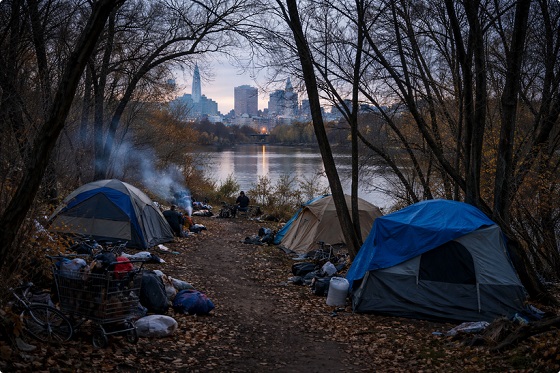
Canada’s homelessness crisis has intensified dramatically, with about 60,000 people homeless this Christmas and chronic homelessness becoming entrenched as shelters overflow and encampments spread. Policy failures in immigration, housing, monetary policy, shelters, harm reduction, and Indigenous governance have driven the crisis. Only reversing these policies can meaningfully address it.
Encampments that were meant to be temporary have become a permanent feature in our communities
As Canadians settle in for the holiday season, 60,000 people across this country will spend Christmas night in a tent, a doorway, or a shelter bed intended to be temporary. Some will have been there for months, perhaps years. The number has quadrupled in six years.
In October 2024, enumerators in 74 Canadian communities conducted the most comprehensive count of homelessness this country has attempted. They found 17,088 people sleeping without shelter on a single autumn night, and 4,982 of them living in encampments. The count excluded Quebec entirely. The real number is certainly higher.
In Ontario alone, homelessness increased 51 per cent between 2016 and 2024. Chronic homelessness has tripled. For the first time, more than half of all homelessness in that province is chronic. People are no longer moving through the system. They are becoming permanent fixtures within it.
Toronto’s homeless population more than doubled between April 2021 and October 2024, from 7,300 to 15,418. Tents now appear in places that were never seen a decade ago. The city has 9,594 people using its shelter system on any given night, yet 158 are turned away each evening because no beds are available.
Calgary recorded 436 homeless deaths in 2023, nearly double the previous year. The Ontario report projects that without significant policy changes, between 165,000 and 294,000 people could experience homelessness annually in that province alone by 2035.
The federal government announced in September 2024 that it would allocate $250 million over two years to address encampments. Ontario received $88 million for ten municipalities. The Association of Municipalities of Ontario calculated that ending chronic homelessness in their province would require $11 billion over ten years. The federal contribution represents less than one per cent of what is needed.
Yet the same federal government found $50 billion for automotive subsidies and battery plants. They borrow tonnes of money to help foreign car manufacturers with EVs, while tens of thousands are homeless. But money alone does not solve problems. Pouring billions into a bureaucratic system that has failed spectacularly without addressing the policies that created the crisis would be useless.
Five years ago, tent cities were virtually unknown in most Canadian communities. Recent policy choices fuelled it, and different choices can help unmake it.
Start with immigration policy. The federal government increased annual targets to over 500,000 without ensuring housing capacity existed. Between 2021 and 2024, refugees and asylum seekers experiencing chronic homelessness increased by 475 per cent. These are people invited to Canada under federal policy, then abandoned to municipal shelter systems already at capacity.
Then there is monetary policy. Pandemic spending drove inflation, which made housing unaffordable. Housing supply remains constrained by policy. Development charges, zoning restrictions, and approval processes spanning years prevent construction at the required scale. Municipal governments layer fees onto new developments, making projects uneconomical.
Shelter policy itself has become counterproductive. The average shelter stay increased from 39 days in 2015 to 56 days in 2022. There are no time limits, no requirements, no expectations. Meanwhile, restrictive rules around curfews, visitors, and pets drive 85 per cent of homeless people to avoid shelters entirely, preferring tents to institutional control.
The expansion of harm reduction programs has substituted enabling for treatment. Safe supply initiatives provide drugs to addicts without requiring participation in recovery programs. Sixty-one per cent cite substance use issues, yet the policy response is to make drug use safer rather than to make sobriety achievable. Treatment programs with accountability would serve dignity far better than an endless supply of free drugs.
Indigenous people account for 44.6 per cent of those experiencing chronic homelessness in Northern Ontario despite comprising less than three per cent of the general population. This overrepresentation is exacerbated by policies that fail to recognize Indigenous governance and self-determination as essential. Billions allocated to Indigenous communities are never scrutinized.
The question Canadians might ask this winter is whether charity can substitute for competent policy. The answer is empirically clear: it cannot. What is required before any meaningful solutions is a reversal of the policies that broke it.
Marco Navarro-Genie is vice-president of research at the Frontier Centre for Public Policy and co-author with Barry Cooper of Canada’s COVID: The Story of a Pandemic Moral Panic (2023).


Largest fraud in US history? Independent Journalist visits numerous daycare centres with no children, revealing massive scam

Be Careful What You Wish For In 2026: Mark Carney With A Majority

Why Japan wants Western Canadian LNG

“Magnitude cannot be overstated”: Minnesota aid scam may reach $9 billion
-
Energy2 days ago
Why Japan wants Western Canadian LNG
-
 Business1 day ago
Mainstream media missing in action as YouTuber blows lid off massive taxpayer fraud
-
 Business2 days ago
Land use will be British Columbia’s biggest issue in 2026
-
 International1 day ago
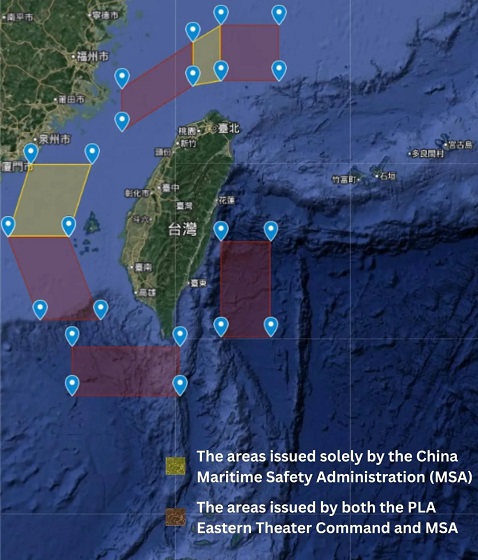
China Stages Massive Live-Fire Encirclement Drill Around Taiwan as Washington and Japan Fortify
-
 Energy1 day ago
Rulings could affect energy prices everywhere: Climate activists v. the energy industry in 2026
-
 Digital ID1 day ago
The Global Push for Government Mandated Digital IDs And Why You Should Worry
-
 Business11 hours ago
Canada needs serious tax cuts in 2026
-
 Business1 day ago
Stripped and shipped: Patel pushes denaturalization, deportation in Minnesota fraud