
Automotive
Can Metal Mining Match the Speed of the Planned Electric Vehicle Transition?

From the Fraser Institute
The governments of Canada, the United States, and many other nations are mandating a shift in vehicle technology: away from vehicles powered primarily by internal combustion engines, and toward vehicles powered primarily with electricity stored on board in batteries.
Canada’s government has established policies designed to push automakers to achieve the government’s goal of having 35 percent of all new medium- and heavy-duty vehicle sales be electric by 2030, rising to 100 percent of all new medium- and heavy-duty vehicle sales being electric by 2040.
The US has set a target requiring 50 percent of all new passenger cars and light trucks sold in 2030 be electric, or largely electric hybrid vehicles. These timelines are ambitious, calling for a major expansion of the prevalence of electric vehicles (EVs) in the major vehicle classes in a very short time—only 7 to 10 years.

Barring breakthrough developments in battery technology, this massive and rapid expansion of battery-electric vehicle production will require a correspondingly massive and rapid expansion of the mining and refining of the metals and rare earth elements critical to battery-electric vehicle technology.
The International Energy Agency (IEA) suggests that to meet international EV adoption pledges, the world will need 50 new lithium mines by 2030, along with 60 new nickel mines, and 17 new cobalt mines. The materials needed for cathode production will require 50 more new mines, and anode materials another 40. The battery cells will require 90 new mines, and EVs themselves another 81. In total, this adds up to 388 new mines. For context, as of 2021, there were only 270 metal mines operating across the US, and only 70 in Canada. If Canada and the US wish to have internal supply chains for these vital EV metals, they have a lot of mines to establish in a very short period.
Historically, however, mining and refining facilities are both slow to develop and are highly uncertain endeavors plagued by regulatory uncertainty and by environmental and regulatory barriers. Lithium production timelines, for example, are approximately 6 to 9 years, while production timelines (from application to production) for nickel are approximately 13 to 18 years, according to the IEA.
The establishment of aggressive and short-term EV adoption goals sets up a potential conflict with metal and mineral production, which is historically characterized by long lead-times and long production timelines. The risk that mineral and mining production will fall short of projected demand is significant, and could greatly affect the success of various governments’ plans for EV transition.
Author:


 From the Daily Caller News Foundation
By David Blackmon
Ever since March 16, when presidential candidate Donald Trump created a controversy by predicting President Joe Biden’s efforts to force Americans to convert their lives to electric-vehicle (EV) lifestyles would end in a “bloodbath” for the U.S. auto industry, the industry’s own disastrous results have consistently proven him accurate.
The latest example came this week when Ford Motor Company reported that it had somehow managed to lose $132,000 per unit sold during Q1 2024 in its Model e EV division. The disastrous first quarter results follow the equally disastrous results for 2023, when the company said it lost $4.7 billion in Model e for the full 12-month period.
While the company has remained profitable overall thanks to strong demand for its legacy internal combustion SUV, pickup, and heavy vehicle models, the string of major losses in its EV line led the company to announce a shift in strategic vision in early April. Ford CEO Jim Farley said then that the company would delay the introduction of additional planned all-electric models and scale back production of current models like the F-150 Lightning pickup while refocusing efforts on introducing new hybrid models across its business line.
General Motors reported it had good overall Q1 results, but they were based on strong sales of its gas-powered SUV and truck models, not its EVs. GM is so gun-shy about reporting EV-specific results that it doesn’t break them out in its quarterly reports, so there is no way of knowing what the real bottom line amounts to from that part of the business. This is possibly a practice Ford should consider adopting.
After reporting its own disappointing Q1 results in which adjusted earnings collapsed by 48% and deliveries dropped by 20% from the previous quarter, Tesla announced it is laying off 10 percent of its global workforce, including 2,688 employees at its Austin plant, where its vaunted Cybertruck is manufactured. Since its introduction in November, the Cybertruck has been beset by buyer complaints ranging from breakdowns within minutes after taking delivery, to its $3,000 camping tent feature failing to deploy, to an incident in which one buyer complained his vehicle shut down for 5 hours after he failed to put the truck in “carwash mode” before running it through a local car wash.

Meanwhile, international auto rental company Hertz is now fire selling its own fleet of Teslas and other EV models in its efforts to salvage a little final value from what is turning out to be a disastrous EV gamble. In a giant fit of green virtue-signaling, the company invested whole hog into the Biden subsidy program in 2021 with a mass purchase of as many as 100,000 Teslas and 50,000 Polestar models, only to find that customer demand for renting electric cars was as tepid as demand to buy them outright. For its troubles, Hertz reported it had lost $392 million during Q1, attributing $195 million of the loss to its EV struggles. Hertz’s share price plummeted by about 20% on April 25, and was down by 55% for the year.
If all this financial carnage does not yet constitute a “bloodbath” for the U.S. EV sector, it is difficult to imagine what would. But wait: It really isn’t all that hard to imagine at all, is it? When he used that term back in March, Trump was referring not just to the ruinous Biden subsidy program, but also to plans by China to establish an EV-manufacturing beachhead in Mexico, from which it would be able to flood the U.S. market with its cheap but high-quality electric models. That would definitely cause an already disastrous domestic EV market to get even worse, wouldn’t it?
The bottom line here is that it is becoming obvious even to ardent EV fans that US consumer demand for EVs has reached a peak long before the industry and government expected it would.
It’s a bit of a perfect storm, one that rent-seeking company executives and obliging policymakers brought upon themselves. Given that this outcome was highly predictable, with so many warning that it was in fact inevitable, a reckoning from investors and corporate boards and voters will soon come due. It could become a bloodbath of its own, and perhaps it should.
David Blackmon is an energy writer and consultant based in Texas. He spent 40 years in the oil and gas business, where he specialized in public policy and communications.
From StosselTV
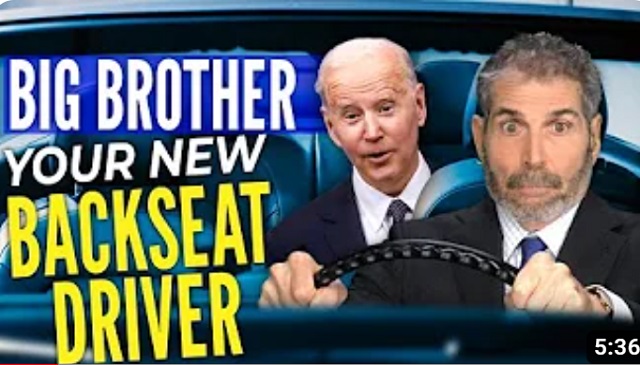
The government may soon be able to shut down your car. Biden’s $1.2 trillion infrastructure bill includes a kill switch for new cars.
In an effort to reduce drunk driving, government wants devices in cars that will monitor and limit impaired driving. But there’s a big problem: these devices give government control over your car.
Automotive engineer and former vintage race car driver Lauren Fix points out the dangers in my video.
After 40+ years of reporting, I now understand the importance of limited government and personal freedom.
——————————————
Libertarian journalist John Stossel created Stossel TV to explain liberty and free markets to young people.

Prior to Stossel TV he hosted a show on Fox Business and co-anchored ABC’s primetime newsmagazine show, 20/20.
Stossel’s economic programs have been adapted into teaching kits by a non-profit organization, “Stossel in the Classroom.” High school teachers in American public schools now use the videos to help educate their students on economics and economic freedom. They are seen by more than 12 million students every year.
Stossel has received 19 Emmy Awards and has been honored five times for excellence in consumer reporting by the National Press Club. Other honors include the George Polk Award for Outstanding Local Reporting and the George Foster Peabody Award.
————
To get our new weekly video from Stossel TV, sign up here: https://www.johnstossel.com/#subscribe ————

Pfizer reportedly withheld presence of cancer-linked DNA in COVID jabs from FDA, Health Canada
The EV ‘Bloodbath’ Arrives Early
Jordan Peterson, Canadian lawyer warn of ‘totalitarian’ impact of Trudeau’s ‘Online Harms’ bill

A Fed-Controlled Digital Dollar Could Mean The End Of Freedom
-
Automotive1 day ago
The EV ‘Bloodbath’ Arrives Early
-
CBDC Central Bank Digital Currency17 hours ago
A Fed-Controlled Digital Dollar Could Mean The End Of Freedom
-
 Business1 day ago
Honda deal latest episode of corporate welfare in Ontario
-
 espionage1 day ago
One in five mail-in voters admitted to committing voter fraud during 2020 election: Rasmussen poll
-
 Frontier Centre for Public Policy13 hours ago
How much do today’s immigrants help Canada?
-
 Brownstone Institute16 hours ago
The Numbers Favour Our Side