
espionage
Biden-Harris admin releasing known, suspected terrorists into US

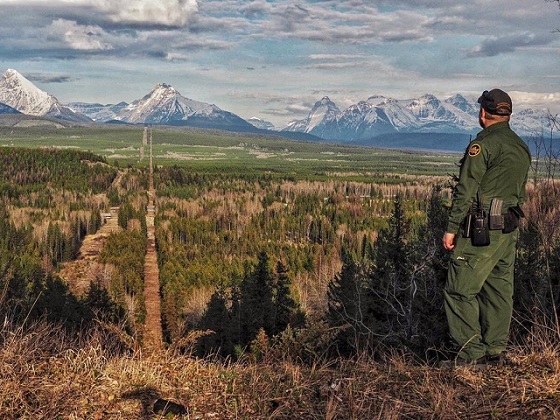
A Border Patrol agent standing watch at the Montana-Canada border in the CBP Spokane Sector. The Spokane Sector covers the U.S.-Canada border along the northwestern section of Montana, part of Idaho, and the eastern part of Washington.
From The Center Square
By
The majority of KSTs are historically apprehended at the northern border, The Center Square first reported. In fiscal 2023, 736 KSTs were apprehended, the greatest number recorded in U.S. history. The majority, 487, were apprehended at the northern border compared to 249 at the southwest border.
Biden-Harris administration policies are resulting in Border Patrol agents releasing known or suspected terrorists (KSTs) into the U.S., a new congressional report states.
“The open-borders policies of President Joe Biden and border czar Vice President Kamala Harris have allowed millions of illegal aliens to enter the United States, including terrorist organizations and other bad actors looking to harm Americans,” creating a national security threat, the U.S. House Judiciary Committee and its Subcommittee on Immigration Integrity, Security, and Enforcement said in a new interim report released Monday.
It points to 99 KSTs released into the U.S. during a two-year period evaluated. It also cites original reporting by The Center Square on terrorism data and warnings given by national security experts about imminent terrorist threats stemming from the border crisis.
The report only appears to focus on KSTs apprehended between ports of entry at the southwest border, excluding the threat posed by the overwhelming majority apprehended at the northern border. Congressional reports continue to appear to only cite one KST data set, instead of four U.S. Customs and Border Protection reports: at and between ports of entry at both borders.
The majority of KSTs are historically apprehended at the northern border, The Center Square first reported. In fiscal 2023, 736 KSTs were apprehended, the greatest number recorded in U.S. history. The majority, 487, were apprehended at the northern border compared to 249 at the southwest border.


The trend continues in fiscal 2024, with 234 KSTs apprehended at the northern border and 125 at the southwest border, according to CBP data last updated July 15.
The total number of KSTs apprehended under the Biden administration is over 1,700, with the greatest number coming through the northern border, The Center Square first reported.
The greatest number of illegal border crossers have entered the U.S. while Biden’s been in office of over 12 million, including two million who evaded capture, known as gotaways, The Center Square first reported. Law enforcement officials estimate the gotaway number is underreported by between 10% and 20% and say they have no idea how many, who or where they are.
“Of the more than 250 illegal aliens on the terrorist watchlist who were encountered by Border Patrol at the southwest border between fiscal years 2021 and 2023, the Department of Homeland Security (DHS) released nearly 100 of them, with at least 34 others in DHS custody but not yet removed from the United States,” the report states, without clarifying the data solely refers to apprehensions at the southwest border between ports of entry.
The report notes that between fiscal years 2021 and 2023, Border Patrol agents apprehended “aliens on the terrorist watchlist from 36 different countries, including places with an active terrorist presence such as Afghanistan, Iraq, Lebanon, Kyrgyzstan, Mauritania, Pakistan, Somalia, Syria, Tajikistan, Turkey, Uzbekistan, and Yemen,” solely referring to one data set.
“So far during fiscal year 2024, Border Patrol has encountered tens of thousands of illegal aliens nationwide from countries that could present national security risks, including 2,134 Afghan nationals, 33,347 Chinese nationals, 541 Iranian nationals, 520 Syrian nationals, and 3,104 Uzbek nationals,” the report states.
It refers to U.S. Customs and Immigration Enforcement officials arresting eight Tajik nationals with potential ISIS ties in June after Border Patrol agents released them into the country. If federal law were followed, they would have been processed for removal instead of being released into the country, former Border Patrol, ICE and CBP officials have told The Center Square.
The Biden-Harris administration released into the U.S. “at least three illegal aliens with potential ISIS ties after the aliens used the Administration’s CBP One app to arrive at a port of entry and be processed into the country,” the report notes, although a different report shows several hundred with ISIS ties were released into the U.S., The Center Square reported.
At a House Judiciary hearing last year, as well as other congressional hearings and in news interviews, DHS Secretary Alejandro Mayorkas has repeatedly claimed “illegal aliens are adequately screened and ‘individuals who pose a threat to national security or public safety are detained,’” the report states. Several DHS Office of Inspector General reports have refuted his claim, providing evidence to the contrary, including foreign nationals not being vetted at airports.
The report also highlights problems in federal immigration courts, pointing to judges who “granted asylum, bond, and other immigration relief to potential terrorists.” The court problem has been compounded by hundreds of thousands of deportation cases being dismissed because DHS failed to file proper paperwork, The Center Square reported.



AI-driven surveillance is shifting from spotting suspects to mapping ordinary life, turning everyday travel into a stream of behavioral data
|
|
espionage
Carney Floor Crossing Raises Counterintelligence Questions aimed at China, Former Senior Mountie Argues

Michael Ma has recently attended events with Chinese consulate officials, leaders of a group called CTCCO, and the Toronto “Hongmen,” where diaspora community leaders and Chinese diplomats advocated Beijing’s push to subordinate Taiwan. These same entities have also appeared alongside Canadian politicians at a “Nanjing” memorial in Toronto.

By Garry Clement
Michael Ma’s meeting with consulate-linked officials proves no wrongdoing—but, Garry Clement writes, the timing and optics highlight vulnerabilities Canada still refuses to treat as a security issue.
I spent years in the Royal Canadian Mounted Police learning a simple rule. You assess risk based on capability, intent, and opportunity — not on hope or assumptions. When those three factors align, ignoring them is negligence.
That framework applies directly to Canada’s relationship with the People’s Republic of China — and to recent political events that deserve far more scrutiny than they have received.
Michael Ma’s crossover to the Liberal Party may be completely legitimate, although numerous observers have noted oddities in the timing, messaging, and execution surrounding Ma’s move, which brings Mark Carney within one seat of majority rule.
There is no evidence of wrongdoing.
But from a law enforcement and national security perspective, that is beside the point. Counterintelligence is not about proving guilt after the fact; it is about identifying vulnerabilities before damage is done — and about recognizing when a situation creates avoidable exposure in a known threat environment.
A constellation of ties and public appearances — reported by The Bureau and the National Post — has fueled questions about Ma’s China-facing judgment and vetting. Those reports describe his engagement with a Chinese-Canadian Conservative network that intervened in party leadership politics by urging Erin O’Toole to resign for his “anti-China” stance after 2021 and later calling for Pierre Poilievre’s ouster — while advancing Beijing-aligned framing on key Canada–China disputes.
The National Post has also reported that critics point to Ma’s pro-Beijing community endorsement during his campaign, and his appearance at a Toronto dinner for the Chinese Freemasons — where consular officials used the forum to promote Beijing’s “reunification” agenda for Taiwan. Ma reportedly offered greetings and praised the organization, but did not indicate support for annexation.
Open-source records also show that the same Toronto Chinese Freemasons and leaders Ma has met from a group called CTCCO sponsored and supported Ontario’s “Nanjing Massacre Commemorative Day” initiative (Bill 79) — a campaign celebrated in Chinese state and Party-aligned media, alongside public praise from PRC consular officials in Canada.
China Daily reported in 2018 that the Nanjing memorial was jointly sponsored by CTCCO and the Chinese Freemasons of Canada (Toronto), supported by more than $180,000 in community donations.
Photos show that PRC consular officials and Toronto politicians appeared at related Nanjing memorial ceremonies, including Zhao Wei, the alleged undercover Chinese intelligence agent later expelled from Canada after The Globe and Mail exposed Zhao’s alleged targeting of Conservative MP Michael Chong and his family in Hong Kong.
The fact that Michael Ma recently met with some of the controversial pro-Beijing community figures and organizations described above — including leaders from the Hongmen ecosystem and the CTCCO — does not prove any nefarious intent in either his Conservative candidacy or his decision to cross the floor to Mark Carney.
But it does demonstrate something Ottawa keeps avoiding: the PRC’s influence work is often conducted in plain sight, through community-facing institutions, elite access, and “normal” relationship networks — the very channels that create leverage, deniability, and political pressure over time.
Canada’s intelligence community has been clear.
The Canadian Security Intelligence Service has repeatedly identified the People’s Republic of China as the most active and persistent foreign interference threat facing Canada. These warnings are not abstract. They are rooted in investigations, human intelligence, and allied reporting shared across the Five Eyes intelligence alliance.
At the center of Beijing’s approach is the United Front Work Department — a Chinese Communist Party entity tasked with influencing foreign political systems, cultivating elites, and shaping narratives abroad. In policing terms, it functions as an influence and access network: operating legally where possible, covertly where necessary, and always in service of the Party’s strategic objectives.
What differentiates the People’s Republic of China from most foreign actors is legal compulsion.
Under China’s National Intelligence Law, Chinese citizens and organizations can be compelled to support state intelligence work and to keep that cooperation secret. In practical terms, that creates an inherent vulnerability for democratic societies: coercive leverage — applied through family, travel, business interests, community pressure, and fear.
This does not mean Chinese-Canadians are suspect.
Quite the opposite — many are targets of intimidation themselves. But it does mean the Chinese Communist Party has a mechanism to exert pressure in ways democratic states do not. Ignoring that fact is not tolerance; it is a failure to understand the threat environment.
In the RCMP, we were trained to recognize that foreign interference rarely announces itself. It operates through relationships, access, favors, timing, and silence. It does not require ideological agreement — only opportunity and leverage.
That is why transparency matters. When political figures engage with representatives of an authoritarian state known for interference operations, the burden is not on the public to “prove” concern is justified. The burden is on officials to explain why there is none — and to demonstrate that basic safeguards are in place.
Canada’s allies have already internalized this reality. Australia, the United States, and the United Kingdom have all publicly acknowledged and legislated against People’s Republic of China political interference. Their assessments mirror ours. Their conclusions are the same.
In the United States, the Linda Sun case — covered by The Bureau — illustrates, in the U.S. government’s telling, how United Front–style influence can be both deniable and effective: built through diaspora-facing proxies, insider access, and relationship networks that rarely look like classic espionage until the damage is done.
And this is not a niche concern.
Think tanks in both the United States and Canada — as well as allied research communities in the United Kingdom and Europe — have documented the scale and persistence of these political-influence ecosystems. Nicholas Eftimiades, an associate professor at Penn State and a former senior National Security Agency analyst, has estimated multiple hundreds of such entities are active in the United States. How many operate in Canada is the question Ottawa still refuses to treat with urgency — and, if an upcoming U.S. report is any indication, the answer may be staggering.
Canada’s hesitation to address United Front networks is not due to lack of information. It is due to lack of resolve.
From a law enforcement perspective, this is troubling. You do not wait for a successful compromise before tightening security. You act when the indicators are present — especially when your own intelligence agencies are sounding the alarm.
National security is not ideological. It is practical.
The Bureau is a reader-supported publication.
To receive new posts and support my work, consider becoming a free or paid subscriber.


Georgia county admits illegally certifying 315k ballots in 2020 presidential election
Communist China arrests hundreds of Christians just days before Christmas

Be Careful What You Wish For In 2026: Mark Carney With A Majority

The Top News Stories That Shaped Canadian Energy in 2025 and Will Continue to Shape Canadian Energy in 2026
-
Bruce Dowbiggin2 days ago
Be Careful What You Wish For In 2026: Mark Carney With A Majority
-
 Business19 hours ago
Largest fraud in US history? Independent Journalist visits numerous daycare centres with no children, revealing massive scam
-
 Energy2 days ago
New Poll Shows Ontarians See Oil & Gas as Key to Jobs, Economy, and Trade
-
 Business20 hours ago
“Magnitude cannot be overstated”: Minnesota aid scam may reach $9 billion
-
 Alberta2 days ago
Alberta project would be “the biggest carbon capture and storage project in the world”
-
 Business2 days ago
Socialism vs. Capitalism
-
 Censorship Industrial Complex17 hours ago
US Under Secretary of State Slams UK and EU Over Online Speech Regulation, Announces Release of Files on Past Censorship Efforts
-
 Energy2 days ago
Canada’s debate on energy levelled up in 2025