
Fraser Institute
Aboriginal rights now more constitutionally powerful than any Charter right



From the Fraser Institute
By Bruce Pardy
A judge of the British Columbia Supreme Court recently found that the Cowichan First Nation holds Aboriginal title over 800 acres of government land in Richmond, British Columbia. Wherever Aboriginal title is found to exist, said the court, it’s a “prior and senior right” to fee simple title, whether public or private. That means it trumps the property that Canadians hold in their houses, farms and factories.
In Canada, property rights do not have constitutional status. No right to property is included in the Charter of Rights and Freedoms. Fee simple title is merely a gloss on the state’s constitutional authority to tax, regulate and expropriate private property as it sees fit. But Aboriginal rights are different. They have become more constitutionally powerful than any Charter right.
In 1968, then-Justice Minister Pierre Trudeau released a consultation paper that proposed a constitutional charter of human rights. It was the first iteration of what would become the Charter. In the paper, Trudeau proposed to guarantee a right to property. So did drafts that followed. But some provincial governments were dead set against entrenching property rights. By 1980, property had been dropped from proposals. The final version of the Charter, adopted in 1982, does not mention it. Canada’s Constitution does not protect property rights.
Except for Aboriginal property. Trudeau’s 1968 paper made no mention of Aboriginal rights, nor did drafts leading up to the 1980 proposal. Aboriginal groups and their supporters launched a campaign to have Aboriginal rights recognized. They succeeded just in time. Section 35, essentially an afterthought, recognized and affirmed the “existing aboriginal and treaty rights of the aboriginal peoples of Canada.” That section was put into the Constitution but not as part of the Charter. That might sound like section 35 is weaker than a Charter right, but it’s the opposite.
Section 35 affirms Aboriginal rights that existed as of 1982. But since 1982, the Supreme Court of Canada has used section 35 to champion, enlarge and reimagine Aboriginal rights. The Court has “discovered” rights never recognized in the law before 1982. In 1997, it articulated a new vision of Aboriginal title. In 2004, it established the Crown’s “duty to consult.” In 2014, it recognized Aboriginal title over a tract of Crown land. In 2021, it gave Aboriginal rights under section 35 to an American Indigenous group.
Now the B.C. court in the Cowichan decision has said that Aboriginal title takes precedence over private property. Last November, a judge of the New Brunswick King’s Bench suggested similarly. Where a claim of Aboriginal title succeeds over land held in fee simple, she said, the court may instruct the government to expropriate the private property and hand it over to the Aboriginal group.

Governments and legislatures have shown little inclination to turn back these developments. But even if they wanted to, the Constitution stands in the way.
Section 33 of the Charter, the “Notwithstanding clause” (NWC), allows provincial legislatures and the federal Parliament to enact legislation notwithstanding the Charter rights guaranteed in sections 2 and 7 to 15. That means that they can pass statutes that might infringe these Charter rights. Use of the NWC clause prevents courts from striking down the statute as unconstitutional. The main part of the NWC reads:
33. (1) Parliament or the legislature of a province may expressly declare in an Act of Parliament or of the legislature, as the case may be, that the Act or a provision thereof shall operate notwithstanding a provision included in section 2 or sections 7 to 15 of this Charter.
Section 35 is not part of the Charter. It is not subject to the NWC. Legislatures cannot ignore it, legislate around it, or change its meaning. Barring a constitutional amendment, courts have exclusive domain over the scope and application of section 35. In the constitutional hierarchy, Aboriginal rights rest above the “fundamental freedoms” and rights of the Charter.
Lest there was any doubt about that status, section 25 of the Charter spells it out. Charter rights and freedoms, the section says, “shall not be construed so as to abrogate or derogate from any aboriginal, treaty or other rights or freedoms that pertain to the aboriginal peoples of Canada.”
That does not mean that Aboriginal rights are absolute. Legislation or government action may sometimes infringe Aboriginal rights. But courts, not legislatures, control when, where, and under what circumstances that can happen. The Supreme Court of Canada has established the process and criteria by which governments must justify infringements of section 35 to the courts’ satisfaction.
Section 35, like much of the rest of the Constitution, is subject to an onerous amending formula. It cannot be easily changed or repealed.

Bruce Pardy
Professor of Law, Queen’s University


From the Fraser Institute
The federal and Alberta governments recently released their much-anticipated Memorandum of Understanding (MOU) outlining what it will take to build a pipeline from Alberta, through British Columbia, to tidewater to get more of our oil to markets beyond the United States.
This was great news, according to most in the media: “Ottawa-Alberta deal clears hurdles for West Coast pipeline,” was the top headline on the Globe and Mail’s website, “Carney inks new energy deal with Alberta, paving way to new pipeline” according to the National Post.
And the reaction from the political class? Well, former federal environment minister Steven Guilbeault resigned from Prime Minister Carney’s cabinet, perhaps positively indicating that this agreement might actually produce a new pipeline. Jason Kenney, a former Alberta premier and Harper government cabinet minister, congratulated Prime Minister Carney and Premier Smith on an “historic agreement.” Even Alberta NDP Leader Naheed Nenshi called the MOU “a positive step for our energy future.”
Finally, as Prime Minister Carney promised, Canada might build critical infrastructure “at a speed and scale not seen in generations.”
Given this seemingly great news, I eagerly read the six-page Memorandum of Understanding. Then I read it again and again. Each time, my enthusiasm and understanding diminished rapidly. By the fourth reading, the only objective conclusion I could reach was not that a pipeline would finally be built, but rather that only governments could write an MOU that no Canadian could understand.
The MOU is utterly incoherent. Go ahead, read it for yourself online. It’s only six pages. Here are a few examples.
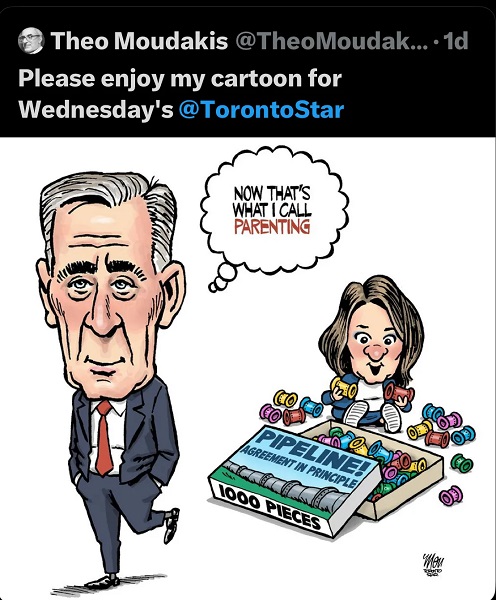
The agreement states that, “Canada and Alberta agree that the approval, commencement and continued construction of the bitumen pipeline is a prerequisite to the Pathways project.” Then on the next line, “Canada and Alberta agree that the Pathways Project is also a prerequisite to the approval, commencement and continued construction of the bitumen pipeline.”
Two things, of course, cannot logically be prerequisites for each other.
But worry not, under the MOU, Alberta and Ottawa will appoint an “Implementation Committee” to deliver “outcomes” (this is from a federal government that just created the “Major Project Office” to get major projects approved and constructed) including “Determining the means by which Alberta can submit its pipeline application to the Major Projects Office on or before July 1, 2026.”
What does “Determining the means” even mean?
What’s worse is that under the MOU, the application for this pipeline project must be “ready to submit to the Major Projects Office on or before July 1, 2026.” Then it could be another two years (or until 2028) before Ottawa approves the pipeline project. But the MOU states the Pathways Project is to be built in stages, starting in 2027. And that takes us back to the circular reasoning of the prerequisites noted above.
Other conditions needed to move forward include:
The private sector must construct and finance the pipeline. Serious question: which private-sector firm would take this risk? And does the Alberta government plan to indemnify the company against these risks?
Indigenous Peoples must co-own the pipeline project.
Alberta must collaborate with B.C. to ensure British Columbians get a cut or “share substantial economic and financial benefits of the proposed pipeline” in MOU speak.
None of this, of course, addresses the major issue in our country—that is, investors lack clarity on timelines and certainty about project approvals. The Carney government established the Major Project Office to fast-track project approvals and provide greater certainty. Of the 11 project “winners” the federal government has already picked, most either already had approvals or are already at an advanced stage in the process. And one of the most important nation-building projects—a pipeline to get our oil to tidewater—hasn’t even been referred to the Major Project Office.
What message does all this send to the investment community? Have we made it easier to get projects approved? No. Have we made things clearer? No. Business investment in Canada has fallen off a cliff and is down 25 per cent per worker since 2014. We’ve seen a massive outflow of capital from the country, more than $388 billion since 2014.
To change this, Canada needs clear rules and certain timelines for project approvals. Not an opaque Memorandum of Understanding.

Niels Veldhuis
President, Fraser Institute
From the Fraser Institute
By Gary Mauser
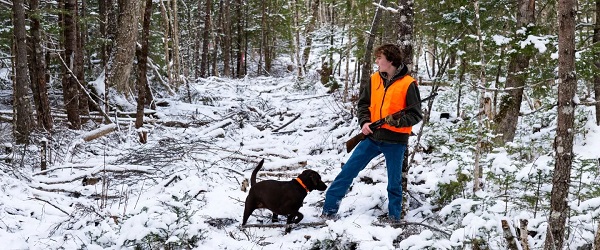
The government told Cape Bretoners they had two weeks to surrender their firearms to qualify for reimbursement or “buyback.” The pilot project netted a grand total of 22 firearms.
Five years after then-prime minister Justin Trudeau banned more than 100,000 types of so-called “assault-style firearms,” the federal government recently made the first attempt to force Canadians to surrender these firearms.
It didn’t go well.
The police chief in Cape Breton, Nova Scotia, volunteered to run a pilot “buyback” project, which began last month. The government told Cape Bretoners they had two weeks to surrender their firearms to qualify for reimbursement or “buyback.” The pilot project netted a grand total of 22 firearms.
This failure should surprise no one. Back in 2018, a survey of “stakeholders” warned the government that firearms owners wouldn’t support such a gun ban. According to Prime Minister Carney’s own Privy Council Office the “program faces a risk of non-compliance.” And federal Public Safety Minister Gary Anandasangaree was recently recorded admitting that the “buyback” is a partisan maneuver, and if it were up to him, he’d scrap it. What’s surprising is Ottawa’s persistence, particularly given the change in the government and the opportunity to discard ineffective policies.
So what’s really going on here?
One thing is for certain—this program is not, and never has been, about public safety. According to a report from the federal Department of Justice, almost all guns used in crimes in Canada, including in big cities such as Toronto, are possessed illegally by criminals, with many smuggled in from the United States. And according to Ontario’s solicitor general, more than 90 per cent of guns used in crimes in the province are illegally imported from the U.S. Obviously, the “buyback” program will have no effect on these guns possessed illegally by criminals.
Moreover, Canadian firearms owners are exceptionally law-abiding and less likely to commit murder than other Canadians. That also should not be surprising. To own a firearm in Canada, you must obtain a Possession and Acquisition Licence (PAL) from the RCMP after initial vetting and daily monitoring for possible criminal activity. Between 2000 and 2020, an average of 12 PAL-holders per year were accused of homicide, out of approximately two million PAL-holders. During that same 10-year period, the PAL-holder firearms homicide rate was 0.63 (per 100,000 PAL-holders) compared to 0.72 (per 100,000 adult Canadians)—that’s 14 per cent higher than the rate for PAL-holders.
In other words, neither the so-called “assault-style firearms” nor their owners pose a threat to the public.
And the government’s own actions belie its claims. If these firearms are such a threat to Canadians, why slow-roll the “buyback” program? If inaction increased the likelihood of criminality by law-abiding firearms owners, why wait five years before launching a pilot program in a small community such as Cape Breton? And why continue to extend the amnesty period for another year, which the government did last month at the same time its pilot project netted a mere 22 firearms?
To ask those questions is to answer them.
Another question—how much will the “buyback” program cost taxpayers?
The government continues to block any attempt to disclose the full financial costs (although the Canadian Taxpayers Federation has launched a lawsuit to try to force the government to honour its Access to Information Act request). But back in 2020 the Trudeau government said it would cost $200 million to compensate firearms owners (although the Parliamentary Budget Officer said compensation costs could reach $756 million). By 2024, the program had spent $67.2 million—remember, that’s before it collected a single gun. The government recently said the program’s administrative costs (safe storage, destruction of hundreds of thousands of firearms, etc.) would reach an estimated $1.8 billion. And according to Carney’s first budget released in November, his government will spend $364 million on the program this fiscal year—at a time of massive federal deficits and debt.
This is reminiscent of the Chretien government’s gun registry fiasco, which wound up costing more than $2 billion even after then-justice minister Allan Rock promised the registry program would “almost break even” after an $85 million initial cost. The Harper government finally scrapped the registry in 2012.
As the Carney government clings to the policies of its predecessor, Canadians should understand the true nature of Ottawa’s gun “buyback” program and its costs.

Gary Mauser
Professor Emeritus, Simon Fraser University

Media bound to pay the price for selling their freedom to (selectively) offend

Sometimes An Ingrate Nation Pt. 2: The Great One Makes His Choice

Recent price declines don’t solve Toronto’s housing affordability crisis

Health Canada report finds euthanasia now accounts for over 5% of deaths nationwide
-
National2 days ago
Media bound to pay the price for selling their freedom to (selectively) offend
-
Bruce Dowbiggin2 days ago
Sometimes An Ingrate Nation Pt. 2: The Great One Makes His Choice
-
Business1 day ago
Recent price declines don’t solve Toronto’s housing affordability crisis
-
MAiD1 day ago
Health Canada report finds euthanasia now accounts for over 5% of deaths nationwide
-
 Daily Caller1 day ago
Tech Mogul Gives $6 Billion To 25 Million Kids To Boost Trump Investment Accounts
-
 Energy1 day ago
Unceded is uncertain
-
 Automotive19 hours ago
Power Struggle: Governments start quietly backing away from EV mandates
-
 Business20 hours ago
New Chevy ad celebrates marriage, raising children